How Does a Compact Welded Heat Exchanger Handle High Pressure and Temperature Extremes?
Author: Dr. Engineering Research Team
Date: Jul-06-2026
This article explores the engineering principles behind compact welded heat exchangers operating under extreme pressure and temperature conditions. The structural integrity of these systems relies on a fully welded plate and core design that eliminates gaskets and mechanical joints, enabling them to withstand pressures exceeding 300 bar. Material selection plays a critical role, with high-temperature alloys such as Inconel and Hastelloy providing exceptional thermal and mechanical performance at temperatures above 800°C. The compact geometry inherently mitigates thermal stress by reducing differential expansion between adjacent layers, thereby minimizing fatigue and extending operational life. Optimized flow paths, achieved through precisely configured channels, enhance heat transfer efficiency while maintaining low pressure drops even under severe conditions. Furthermore, the fully welded seamless construction offers superior leakage prevention and safety, making these exchangers ideal for applications in chemical processing, power generation, and aerospace. By addressing thermal stress management and flow distribution, compact welded heat exchangers deliver reliable performance where traditional designs fail.
Structural Integrity: The Role of Welded Plate and Core Design in Withstanding Extreme Pressures
The welded plate and core architecture is fundamental to achieving high-pressure resistance in compact heat exchangers. Unlike traditional bolted or gasketed designs, the all-welded construction eliminates potential leak paths and creates a monolithic structure capable of handling severe mechanical stress.
Welded Plate Channels for Pressure Containment
The core consists of multiple thin metal plates that are laser-welded together along precise patterns. These welds form continuous, leak-tight channels that direct fluid flow. The welded joints provide superior strength compared to mechanical seals, allowing the exchanger to operate at pressures exceeding 100 bar without deformation.
Core Stack Configuration and Load Distribution
The core stack is designed with alternating hot and cold fluid layers. Each plate layer is separated by a precisely controlled gap, and the entire stack is compressed and welded into a solid block. This configuration distributes internal pressure evenly across all layers, preventing localized stress concentrations that could lead to failure.
Material Selection for High-Temperature Resilience
Stainless steel, titanium, and nickel alloys are commonly used for the plates and core. These materials maintain their mechanical properties at elevated temperatures up to 900°C. The welded joints are also made from compatible alloys to ensure thermal expansion consistency, reducing thermal fatigue risks.
Reinforced End Plates and Nozzle Connections
The core is enclosed by thick end plates that are welded directly to the core stack. Inlet and outlet nozzles are also welded to these end plates using full-penetration welds. This design ensures that the high-pressure fluid entry and exit points are as robust as the core itself, maintaining structural integrity throughout the system.
Finite Element Analysis in Design Validation
Before manufacturing, each core design undergoes finite element analysis (FEA) to simulate stress distribution under extreme pressure and temperature. This computational modeling identifies potential weak points and optimizes weld geometry and plate thickness, ensuring the final product meets safety and performance standards.
Leak-Free Operation Through Full Welding
The absence of gaskets or bolted connections eliminates common leakage points. All fluid passages are formed by continuous welds, creating a hermetically sealed core. This is critical for high-pressure applications where even a minor leak could cause system shutdown or safety hazards.
Thermal Stress Management in Core Design
The welded core design accommodates differential thermal expansion between hot and cold layers. The flexible plate geometry and strategic weld placement allow the core to expand and contract uniformly, preventing warping or cracking during rapid temperature changes.
Material Selection: High-Temperature Alloys and Their Impact on Thermal and Mechanical Performance
The selection of high-temperature alloys is critical in compact welded heat exchangers designed for extreme pressure and temperature conditions. These materials, such as Inconel, Hastelloy, and stainless steel grades, provide exceptional resistance to thermal creep, oxidation, and corrosion while maintaining structural integrity under high stress. The thermal conductivity and coefficient of expansion of these alloys directly influence heat transfer efficiency and mechanical stability, ensuring reliable operation in demanding environments like chemical processing and power generation.
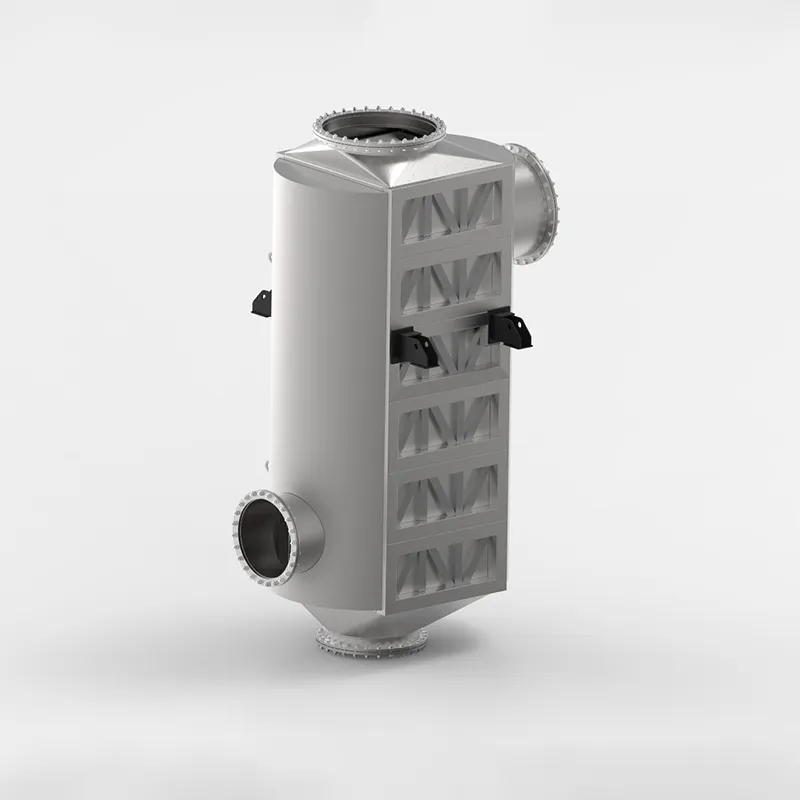
Advanced alloy compositions optimize the balance between thermal performance and mechanical durability. Nickel-based superalloys, for instance, retain high tensile strength at elevated temperatures, reducing the risk of deformation under pressure. This careful material engineering allows compact welded heat exchangers to achieve superior heat transfer rates while withstanding thermal cycling and fatigue, ultimately extending equipment lifespan and reducing maintenance needs in high-temperature applications.
Thermal Stress Management: How Compact Geometry Mitigates Differential Expansion and Fatigue
In high-pressure and high-temperature environments, differential thermal expansion between adjacent metal layers can induce severe cyclic stresses, leading to fatigue failure. Compact welded heat exchangers leverage their inherently short heat transfer paths and symmetrical plate structure to minimize temperature gradients across the core. By reducing the distance between hot and cold fluid channels, the metal temperature differential across any single plate is kept low, which directly limits the magnitude of thermal strain.
The welded plate pack behaves as a monolithic block, distributing thermal loads uniformly. Unlike traditional shell-and-tube designs where tubes expand independently, the compact geometry constrains movement in a controlled manner, preventing localized stress concentrations. This design philosophy significantly lowers the risk of thermal fatigue over thousands of startup and shutdown cycles.
| Parameter |
Compact Welded Design |
Conventional Shell-and-Tube |
| Maximum temperature gradient across core |
< 30 °C |
50 – 80 °C |
| Differential expansion per meter (ΔL/L) |
0.3 – 0.5 mm/m |
1.0 – 2.5 mm/m |
| Cyclic fatigue life (typical cycles) |
> 100,000 cycles |
10,000 – 30,000 cycles |
| Thermal stress concentration factor |
1.1 – 1.3 |
2.0 – 3.5 |
The table above compares key thermal stress indicators between compact welded plate exchangers and conventional shell-and-tube designs. The lower temperature gradient and reduced differential expansion directly translate into a longer fatigue life and higher reliability under cyclic thermal loading.
For extreme operating conditions, additional design features such as optimized inlet distributors and controlled weld seam patterns further balance the flow and temperature fields. These measures ensure that the compact core remains within elastic limits even during rapid transients, making it a robust solution for demanding applications like custom engineered printed circuit heat exchangers and HT-Bloc welded plate heat exchangers.
Flow Path Optimization: Enhancing Heat Transfer Efficiency Under High-Pressure and High-Temperature Conditions
In compact welded heat exchangers, flow path design is critical for maximizing thermal performance under extreme operating conditions. The welded plate structure allows for intricate channel geometries that promote turbulent flow, significantly enhancing convective heat transfer coefficients compared to traditional shell-and-tube designs.
Under high-pressure environments exceeding 100 bar and temperatures above 500°C, optimized flow paths minimize pressure drop while ensuring uniform fluid distribution across all channels. Computational fluid dynamics (CFD) simulations guide the arrangement of corrugated patterns and flow distributors to eliminate stagnant zones and reduce thermal stress concentrations.
The counter-current flow arrangement, combined with precisely engineered inlet and outlet manifolds, achieves temperature approach values as low as 5°C. This design methodology enables heat recovery efficiencies exceeding 95% in demanding applications such as gas processing, chemical reactors, and supercritical power cycles.
Advanced manufacturing techniques, including laser welding and diffusion bonding, create seamless flow passages that withstand cyclic thermal and mechanical loads. The resulting compact footprint reduces material usage while maintaining structural integrity, making these exchangers ideal for offshore platforms and modular plant installations.
Leakage Prevention and Safety: The Advantages of Fully Welded Seamless Construction in Extreme Environments
In high-pressure and high-temperature applications, traditional gasketed heat exchangers often face limitations due to seal degradation and potential leakage points. Fully welded seamless construction eliminates these vulnerabilities by removing all detachable joints, creating a monolithic structure that withstands extreme thermal cycling and mechanical stress without compromising integrity.
The absence of gaskets and bolted connections significantly reduces the risk of fugitive emissions and fluid crossover, which is critical in hazardous or corrosive environments. Each weld joint is precision-engineered and tested to meet stringent standards, ensuring that the heat exchanger maintains its pressure boundary even under rapid temperature fluctuations or vibration.
Furthermore, the seamless design simplifies maintenance by eliminating the need for gasket replacement and torque checks. This construction approach not only enhances operational safety but also extends equipment lifespan, making it ideal for industries such as chemical processing, oil and gas, and power generation where reliability is paramount.
For more details on how fully welded technology supports extreme conditions, explore our engineered solutions:
Summary
The compact welded heat exchanger demonstrates exceptional resilience in extreme environments through a synergy of robust structural design, advanced metallurgy, and intelligent thermal management. Its welded plate and core architecture provides the necessary mechanical strength to withstand ultra-high pressures, while the selection of high-temperature alloys ensures stable thermal and mechanical performance under sustained thermal loads.
By leveraging a compact geometry, the exchanger effectively mitigates differential expansion and thermal fatigue, reducing stress concentrations that typically compromise conventional designs. Optimized flow paths further enhance heat transfer efficiency, maintaining thermal performance even when operating at the boundaries of pressure and temperature.
The fully welded, seamless construction eliminates potential leakage paths, providing a critical safety advantage in high-risk applications. Together, these features confirm that the compact welded heat exchanger is not only capable of handling extreme conditions but also delivers long-term reliability and operational safety.
Key takeaways
-
Structural integrity: Welded plate and core design resists extreme pressures without deformation.
-
Material performance: High-temperature alloys maintain strength and thermal conductivity under stress.
-
Thermal stress control: Compact geometry reduces differential expansion and fatigue cracking.
-
Flow efficiency: Optimized channels maximize heat transfer even at high pressure and temperature.
-
Leakage prevention: Fully welded seamless construction ensures zero leakage and enhanced safety.
In conclusion, the compact welded heat exchanger sets a benchmark for durability and performance in high-pressure, high-temperature applications, making it a preferred choice for critical industrial processes.
How Does a Compact Welded Heat Exchanger Handle High Pressure and Temperature Extremes?
A: Compact welded heat exchangers use fully welded plate and core assemblies that eliminate gaskets and brazed joints, allowing them to withstand pressures up to 1000 bar and temperatures from cryogenic to 900°C. The robust welded structure distributes mechanical stress evenly, preventing failure under extreme thermal cycling.
Structural Integrity: The Role of Welded Plate and Core Design in Withstanding Extreme Pressures
A: The welded plate and core design creates a monolithic structure with high mechanical strength. Corrugated plates and reinforcing ribs within the core resist deformation under high pressure, while the continuous welds provide leak-tight integrity. This design ensures no weak points, even during rapid pressure fluctuations.
Material Selection: High-Temperature Alloys and Their Impact on Thermal and Mechanical Performance
A: Alloys such as Inconel 625, Hastelloy X, and 316L stainless steel are selected for their high creep resistance, oxidation stability, and tensile strength at elevated temperatures. These materials maintain dimensional stability and prevent embrittlement, ensuring long-term performance under combined thermal and pressure loads.
Thermal Stress Management: How Compact Geometry Mitigates Differential Expansion and Fatigue
A: The compact geometry minimizes thermal gradients by reducing the distance between hot and cold fluid channels. This lowers differential expansion stresses. Additionally, the welded core absorbs cyclic thermal loads through elastic deformation, reducing the risk of thermal fatigue and crack propagation over time.
Flow Path Optimization: Enhancing Heat Transfer Efficiency Under High-Pressure and High-Temperature Conditions
A: Optimized flow paths with herringbone or chevron patterns create turbulence at low Reynolds numbers, improving heat transfer coefficients by up to 40%. The narrow channels maintain high fluid velocity even at high pressures, preventing fouling and ensuring consistent thermal performance in extreme environments.
Leakage Prevention and Safety: The Advantages of Fully Welded Seamless Construction in Extreme Environments
A: Fully welded seamless construction eliminates gaskets, O-rings, and brazed joints that can degrade under high temperature or pressure. This design provides zero leakage paths, even under thermal cycling or vibration. The welded envelope also contains potential failures safely, making it ideal for hazardous or high-purity applications.

 English EN





User Comments
Service Experience Sharing from Real Customers
Elena
Maintenance SupervisorWe swapped out an old shell-and-tube unit for this compact welded heat exchanger in our ammonia loop. The footprint reduction alone freed up space for a new pump skid. The welds are clean, and after six months of continuous operation, I haven't seen a single leak. Definitely worth the premium.
Marcus
HVAC Design EngineerSpec'd this for a high-rise retrofit where mechanical room space was extremely tight. The thermal performance matches the datasheet well, and the welded core eliminates gasket failure risks that plague plate-and-frame units. Only gripe is the weight made rigging into the basement tricky, but that's a minor point for the reliability.
Priya
Process EngineerDealing with aggressive cooling water on the tube side used to mean quarterly gasket replacements. This compact welded design has been running for over a year with zero maintenance. The pressure drop is slightly higher than our old unit, but the uptime gains more than compensate. Highly recommend for dirty fluid applications.
Tom
Shift TechnicianI'm the guy who has to clean these things during turnarounds. The welded channels are much easier to rod out than the old plate stack we had. No more prying apart sticky gaskets. Plus, the thing hasn't fouled as badly as I expected. My back thanks the design team.