
 English EN


TL;DR — The quick answer
Efficiency: welded plate units transfer heat far more efficiently (higher U-value) than shell-and-tube.
Footprint & weight: a welded plate exchanger is a fraction of the size and weight for the same duty.
Pressure/temperature: both handle severe service; shell-and-tube still leads at the very highest extremes.
Cleaning: shell-and-tube offers easy tube-side mechanical access; welded plate uses CIP.
Verdict: for most modern process duties, welded plate wins on efficiency, space and installed cost.
When a duty exceeds the gasketed envelope, the classic choice has been the shell-and-tube heat exchanger — but the fully welded plate heat exchanger now challenges it on almost every metric. This guide compares the two on efficiency, footprint, pressure/temperature, cleaning and cost, so you can choose with confidence. It reflects how SHPHE positions its HT-Bloc and TP welded platforms against traditional shell-and-tube.
The short version: welded plate technology brings the high efficiency and compactness of plate exchangers into the high-pressure, high-temperature territory that shell-and-tube used to own — usually at lower installed cost. Shell-and-tube retains a few niches, but for the majority of process duties the welded plate is the stronger modern answer.
How do the two technologies work?
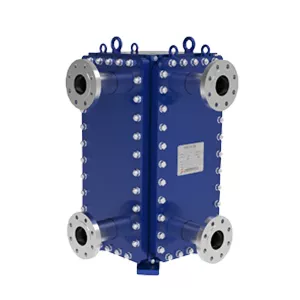
A shell-and-tube exchanger passes one fluid through a bundle of tubes and the other around them inside a cylindrical shell. It is rugged and familiar, but the smooth tubes give relatively low turbulence and heat transfer, so it needs a large surface area — and therefore a large, heavy vessel. A welded plate exchanger stacks corrugated plates whose channels force intense turbulence, giving a much higher heat-transfer coefficient in a compact pack. Welding the pack (rather than gasketing it) lets it reach the high pressures and temperatures that used to require shell-and-tube, while keeping the plate's efficiency and small footprint.
Which is more efficient?
The welded plate exchanger, decisively. Its corrugated channels create turbulence at modest flow rates, raising the overall heat-transfer coefficient (U-value) several-fold over a smooth-tube shell-and-tube. That means it needs far less surface area for the same duty — and it can achieve a much closer temperature approach (often 1–5 °C), recovering more heat or hitting tighter targets. Higher efficiency also cuts the energy cost of the process over the exchanger's life, an increasingly important factor as plants decarbonise.
How do footprint and weight compare?
This is where the gap is most visual. Because the welded plate exchanger transfers heat so efficiently, it packs the required area into a unit that is typically a fraction of the size and weight of an equivalent shell-and-tube. That matters for plot-space-constrained plants, offshore platforms where weight is critical, and any retrofit into a tight space. Lower weight also cuts foundation, lifting and installation costs.
Pressure, temperature and severe service
| Attribute | Welded plate | Shell-and-tube |
|---|---|---|
| Heat-transfer efficiency | Very high | Lower |
| Footprint / weight | Compact / light | Bulky / heavy |
| Temperature approach | Close (1–5 °C) | Wider |
| Very extreme P/T | High | Highest |
| Mechanical (tube) cleaning | CIP | Easy access |
| Installed cost | Usually lower | Higher |
Both technologies handle high pressure and temperature. Shell-and-tube still leads at the very highest extremes and for very heavily fouling or solids-laden fluids where tube-side rodding is preferred. For the broad middle of process duties, though, the welded plate matches the envelope while winning on efficiency and space.
What about cleaning and maintenance?
Shell-and-tube's advantage is mechanical cleaning: the tube side can be rodded or hydro-blasted, which suits heavily fouling services. A welded plate pack cannot be opened, so it relies on cleaning-in-place (CIP) — effective for low-to-moderate fouling. This is the key selection question: if the fluid fouls heavily and needs frequent mechanical cleaning, shell-and-tube (or a specialised wide-gap plate unit) may fit better; if fouling is manageable, the welded plate's efficiency and compactness win. Digital monitoring such as SHPHE's Smart Eye keeps CIP planned rather than reactive.
Which costs less over its life?
Installed cost usually favours the welded plate: it is smaller and lighter, so foundations, lifting, piping and plot space all cost less, and its higher efficiency lowers pumping and energy cost. Over a decade, fewer failure points (versus a gasketed unit) and lower energy use often give it a lower total cost of ownership than a shell-and-tube — provided the duty suits CIP cleaning. Where heavy mechanical cleaning is unavoidable, the shell-and-tube's serviceability can tip the balance back. The right answer is duty-specific, which is why an engineering assessment beats a rule of thumb.
Why is the temperature approach so important?
The temperature approach — how close the outlet of one stream gets to the inlet of the other — is where the welded plate exchanger quietly saves money. Its true countercurrent flow lets it reach an approach of just a few degrees, so it can recover more heat from a process stream or hit a tighter target temperature than a shell-and-tube, which is limited by its cross-flow baffled geometry to a wider approach. In a heat-recovery duty, that tighter approach translates directly into more recovered energy every hour of operation, which compounds into substantial fuel or utility savings over a year. For plants under pressure to cut energy use and carbon, the ability to recover heat down to a close approach is not a nicety — it is a core reason to specify plate technology, and it is a capability a bulky shell-and-tube simply cannot match at the same size and cost.
Are there duties where shell-and-tube still wins?
Yes, and a balanced engineer acknowledges them. Shell-and-tube retains an edge in a few situations: at the very highest design pressures and temperatures beyond even welded plate capability; for extremely heavily fouling or solids-laden fluids where frequent mechanical rodding of the tube side is the only practical cleaning; where an existing plant is standardised on shell-and-tube spares and skills; and where a code or client specification mandates it. In these cases the shell-and-tube's brute ruggedness and mechanical serviceability outweigh the plate's efficiency and compactness. For the broad majority of modern process duties, though — closed cooling loops, interchangers, condensers, heat recovery on manageable fluids — the welded plate is the better technical and economic choice, and increasingly the default that engineers reach for when modernising a plant.
Replacing shell-and-tube with welded plate
SHPHE's HT-Bloc and TP welded platforms are frequently specified where a plant wants the pressure/temperature capability of a shell-and-tube but the efficiency and compactness of a plate exchanger. By welding the plate pack, SHPHE lifts the operating envelope while keeping the high U-value and small footprint, so a bulky shell-and-tube can be replaced with a compact welded unit that recovers more heat, occupies less plot, and cuts installation and energy cost. Metallurgy is matched to the media, and the pack is custom-engineered to the exact duty. Certified to ASME, NB, CE, BV and SGS with 30+ patents since 2005, SHPHE helps engineers modernise legacy shell-and-tube duties across oil & gas, chemical, power and metallurgy.
Source: SHPHE product information. See the HT-Bloc welded range.
What about installation and retrofit?
Installation is often where the welded plate exchanger's compactness pays off most visibly. Its small size and low weight mean lighter foundations, simpler lifting, shorter pipe runs and less structural steel than a shell-and-tube of the same duty — savings that land before the unit even starts operating. In a retrofit, the plate exchanger can frequently drop into a space where no larger shell-and-tube would fit, letting a plant add or upgrade heat-recovery capacity without expanding the building or platform. Offshore, where every tonne of deck weight carries a cost, the weight saving alone can justify the choice. These installation and retrofit advantages are real money that a purchase-price comparison misses, and they consistently favour the compact welded plate design.
How do you decide for your plant?
A practical decision path keeps the choice objective. First, confirm the design pressure and temperature — if they are within welded-plate capability (they usually are), the plate stays in contention. Second, assess the fouling tendency: if the fluid needs frequent mechanical cleaning, lean shell-and-tube or a specialised wide-gap plate; if fouling is manageable with CIP, the welded plate wins. Third, weigh space and weight — tight plots, offshore decks and retrofits favour the compact plate strongly. Fourth, run the total cost of ownership, including installation, energy and maintenance over the asset's life, not just the purchase price. Working through these four questions with a supplier who makes both technologies — or who can model the plate option honestly against your existing shell-and-tube — turns a habitual choice into an engineered one. In the great majority of cases that analysis now points to a welded plate exchanger, which is why so many plants are replacing ageing shell-and-tube units with compact, efficient welded plate designs as they modernise and decarbonise.
The momentum is clear: as energy costs and space constraints rise and plate-welding technology matures, the welded plate exchanger keeps taking share from shell-and-tube across process industry. Understanding exactly where each still wins lets you make the right call for each duty rather than defaulting to what was specified a generation ago.
As a specialist plate-heat-exchanger manufacturer, SHPHE (Shanghai Heat Transfer Equipment Co., Ltd.) custom-engineers welded plate exchangers to replace or outperform shell-and-tube, backed by ASME/NB/CE/BV/SGS certification and full thermal design.
Send SHPHE your conditions for a compact, efficient welded plate design.
Consult our engineers →| Duty | Best choice | Reason |
|---|---|---|
| Compact / weight-limited | Welded plate | Fraction of size & weight |
| High efficiency / close approach | Welded plate | Turbulent channels |
| Extreme P/T beyond weld limit | Shell-and-tube | Highest envelope |
| Very heavy fouling (rodding) | Shell-and-tube | Open tube access |
Frequently asked questions
Is a welded plate heat exchanger more efficient than shell-and-tube?
Yes — its corrugated channels give a much higher heat-transfer coefficient, so it needs far less area and can reach a closer temperature approach than a smooth-tube shell-and-tube.
How much smaller is a welded plate exchanger?
For the same duty it is typically a fraction of the size and weight of a shell-and-tube, cutting plot space, foundations and installation cost.
Can a welded plate exchanger handle high pressure and temperature?
Yes — welding the pack removes the gasket limit, so it handles high pressure and temperature; shell-and-tube still leads only at the very highest extremes.
Which is easier to clean?
Shell-and-tube allows mechanical tube cleaning, which suits heavy fouling. Welded plate uses cleaning-in-place, best for low-to-moderate fouling.
Which has the lower total cost of ownership?
Usually the welded plate, thanks to smaller footprint, lower installation cost and higher efficiency — provided the duty suits CIP cleaning.
Sources & further reading: SHPHE product information; general heat-exchanger comparison practice. Suitability depends on the specific duty, fluids and cleaning needs — confirm with a thermal design.