
 English EN


TL;DR — The quick answer
What it is: a fully welded, gasket-free plate pack in a frame — plate efficiency with shell-and-tube pressure/temperature capability.
Why it's used: handles high pressure, high temperature and aggressive media that exceed the gasketed envelope.
Cleaning: chemical / CIP rather than opening the frame — so it suits low-to-moderate fouling.
Versatile base: the most adaptable platform for custom high-duty thermal solutions.
Best for: oil & gas, chemical, power and metallurgy duties beyond gasketed limits.
When a duty exceeds what a gasketed unit can handle — higher pressure, higher temperature, or media a gasket can't survive — the answer is a fully welded plate heat exchanger. SHPHE's HT-Bloc is exactly this: a gasket-free welded plate pack that combines the high efficiency of a plate exchanger with the pressure and temperature resistance of a shell-and-tube. This guide explains how it works, where it wins, and how to specify it.
The HT-Bloc is best understood as the most versatile foundation in the plate-heat-exchanger family. Because it removes the gasket — the component that caps a gasketed unit's envelope — it opens the door to severe-service duties while keeping the compactness and thermal performance that make plate technology attractive in the first place.
What is an HT-Bloc welded plate heat exchanger?
An HT-Bloc welded plate heat exchanger is built from a fully welded plate pack held in a frame. Unlike a gasketed unit, the plates are welded together rather than sealed by elastomeric gaskets, so there is no gasket to limit pressure, temperature or chemical compatibility. This gives it a unique combination: the high heat-transfer efficiency and compact footprint of a plate exchanger, plus the high pressure and temperature resistance of a shell-and-tube. That versatility is why SHPHE uses the HT-Bloc as the adaptable base to engineer bespoke thermal solutions across demanding industrial sectors.
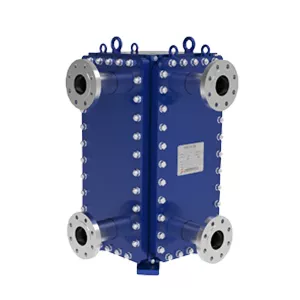
How does removing the gaskets change the envelope?
The gasket is the weakest link in a gasketed unit — it caps pressure (typically ~25 bar), temperature (~180 °C) and chemical range. Welding the plate pack removes that limit, letting the exchanger operate at the higher pressures and temperatures the metallurgy allows, and handle aggressive fluids that would attack a gasket. The trade-off is cleaning: a welded pack can't be opened plate-by-plate, so it is cleaned by circulating chemicals (CIP) rather than mechanically. That makes it ideal for duties with low-to-moderate fouling where the higher envelope matters more than open-frame access.
Where is the HT-Bloc used?
The HT-Bloc suits high-duty applications across process industry:
| Industry | Typical duty |
|---|---|
| Oil & gas | High-pressure process heating/cooling, interstage duties |
| Chemical | Aggressive media, high-temperature reactions |
| Power | High-temperature closed loops, energy recovery |
| Metallurgy | Severe cooling duties, high heat flux |
HT-Bloc vs gasketed vs shell-and-tube
Choosing between designs comes down to the envelope and the cleaning need:
| Attribute | Gasketed | HT-Bloc welded | Shell-and-tube |
|---|---|---|---|
| Pressure / temp | Limited | High | High |
| Efficiency / footprint | High / compact | High / compact | Lower / bulky |
| Open-frame cleaning | Yes | CIP / chemical | Tube access |
| Aggressive media | Gasket-limited | Yes | Yes |
The HT-Bloc effectively gives you shell-and-tube ruggedness in a plate-exchanger footprint and efficiency — a strong middle ground for severe duties that don't need frequent mechanical cleaning.
How do you specify an HT-Bloc?
Specification follows the same duty logic as any plate exchanger — flow rates, temperatures, heat load, pressure drop — but with the emphasis on the design pressure, temperature and media that pushed you beyond the gasketed envelope. From these, the engineer selects the plate material (stainless, titanium or high alloy for corrosion), the welded pack geometry, and the frame rating. Because SHPHE custom-configures the HT-Bloc rather than supplying a fixed model, the unit is engineered to the exact conditions — handling high viscosity, extreme temperature or tight space constraints as the duty demands.
Which materials suit a welded plate heat exchanger?
Because the HT-Bloc removes the gasket as the limiting factor, the plate metallurgy becomes the key to its envelope and corrosion resistance. Stainless steels (304/316L) cover general high-pressure duties; titanium is chosen for seawater, brines and chlorides where stainless would pit; and high alloys such as 254 SMO, Hastelloy or nickel alloys handle strong acids and aggressive process chemicals. The weld metallurgy is matched to the plate so the joints share the same corrosion resistance as the plate surface — a detail that is critical in severe service, because a weld that corrodes faster than the plate becomes the failure point. Selecting the right combination of plate and weld material for both fluids is where a specialist manufacturer adds real value: it ensures the welded pack lasts as long as its high-pressure capability promises, rather than being undermined by a corrosion mismatch. SHPHE selects the metallurgy to the exact media, so the HT-Bloc delivers both the pressure/temperature envelope and the service life the duty requires.
Custom-engineered for severe service
SHPHE positions the HT-Bloc as a tailored solution, not a stock item: its engineers custom-configure the welded plate pack to overcome specific challenges — high-viscosity media, extreme temperatures, or strict space constraints — that defeat conventional exchangers. By combining plate-exchanger efficiency with shell-and-tube pressure and temperature capability, and selecting corrosion-appropriate metallurgy, the HT-Bloc becomes the versatile base for bespoke thermal solutions across oil & gas, chemical, power and metallurgy. Certified to ASME, NB, CE, BV and SGS and backed by 30+ patents and thermal-simulation capability since 2005, each unit is designed to the customer's exact severe-service conditions.
Source: SHPHE product information. See the HT-Bloc welded plate heat exchanger page.
How do you maintain a welded plate heat exchanger?
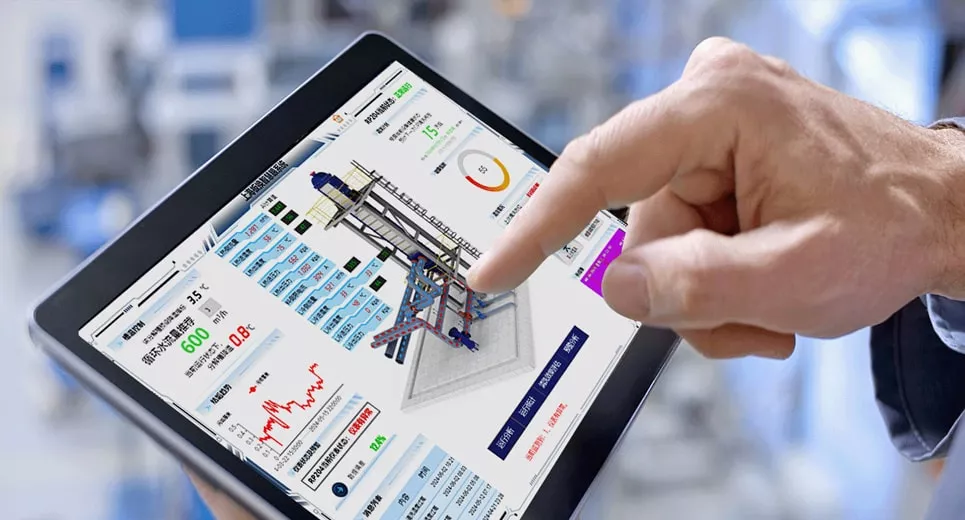
Because the pack is welded, maintenance is chemical rather than mechanical: a cleaning-in-place (CIP) circuit circulates a cleaning solution to dissolve scale and fouling without opening the unit. This is effective for low-to-moderate fouling duties. Monitoring pressure drop and thermal performance indicates when a CIP is due — and digital monitoring such as SHPHE's Smart Eye predicts it before performance degrades. For heavily fouling or fibrous fluids, a different SHPHE platform — the wide-gap or TP welded unit — is the better fit.
What are the cost and lifecycle benefits?
Although a welded exchanger carries no cheap gaskets, its lifecycle economics are compelling for the right duty. Removing gaskets removes the consumable most likely to fail and leak, so the HT-Bloc avoids the recurring cost of reglasketing and the unplanned downtime a gasket leak causes. Its compact plate footprint means lower installation cost and a smaller plot than an equivalent shell-and-tube, and its high efficiency reduces the pumping and energy cost of moving heat. Against these gains sits the trade-off that it cannot be opened for mechanical cleaning, so it should be applied where fouling is low-to-moderate and CIP is effective. Weighed over a decade of operation — fewer failure points, less downtime, smaller footprint, high efficiency — the HT-Bloc frequently delivers a lower total cost of ownership than either a gasketed unit pushed beyond its comfort zone or a bulky shell-and-tube, which is why it is increasingly specified for severe-service process duties. In practice, engineers increasingly treat the HT-Bloc as the default first choice whenever a duty crosses the gasketed pressure or temperature ceiling but does not demand frequent mechanical cleaning — reserving the specialised wide-gap and TP platforms for genuinely fouling or fibrous streams, and shell-and-tube only where code or legacy standardisation requires it.
When should you choose HT-Bloc over other welded types?
SHPHE offers several welded platforms, and matching the right one to the fluid is part of good engineering. The HT-Bloc is the versatile all-rounder for high-pressure, high-temperature duties with clean-to-moderate fouling. The TP welded (shell-and-plate) unit is chosen when the media carries particles, high viscosity or fibres that would foul a compact pack, adding wear-resistant geometry and CIP. The wide-gap welded unit is for fibrous, high-solids or crystallising fluids that need unobstructed channels to avoid clogging. And the PCHE serves ultra-high-pressure, compact duties such as supercritical CO2 or hydrogen. Choosing between them starts with the fluid: how clean it is, how viscous, how aggressive, and at what pressure and temperature. For a duty that simply exceeds the gasketed envelope but is otherwise well-behaved, the HT-Bloc is usually the most cost-effective and versatile answer.
This ability to move a customer across platforms without changing supplier is a real advantage. As conditions or fluids change over a plant's life, the same engineering team can re-specify from HT-Bloc to wide-gap or PCHE, keeping a single accountable partner for design, manufacture and after-sales — which shortens qualification and simplifies support.
As a specialist plate-heat-exchanger manufacturer since 2005, SHPHE (Shanghai Heat Transfer Equipment Co., Ltd.) custom-engineers HT-Bloc welded, gasketed, wide-gap, pillow-plate and PCHE units, backed by ASME/NB/CE/BV/SGS certification and 30+ patents.
Send SHPHE your pressure, temperature and media for a custom HT-Bloc design.
Consult our engineers →Ultimately the HT-Bloc exists to extend the plate exchanger's efficiency and compactness into pressures, temperatures and media that once demanded a shell-and-tube. Where a duty is too aggressive for a gasketed unit but still wants the plate's performance, the fully-welded block is often the ideal answer, and SHPHE engineers each one to the specific service for long, reliable life.
Frequently asked questions
What is an HT-Bloc welded plate heat exchanger?
A fully welded, gasket-free plate pack in a frame that combines the high efficiency and compact footprint of a plate exchanger with the high pressure and temperature resistance of a shell-and-tube unit.
Why choose a welded plate heat exchanger over a gasketed one?
Because it removes the gasket that caps pressure (~25 bar), temperature (~180 °C) and chemical range, letting the unit handle higher pressure and temperature and aggressive media beyond the gasketed envelope.
How is a welded plate heat exchanger cleaned?
By cleaning-in-place (CIP) — circulating a chemical cleaning solution — rather than opening the frame, which makes it best for low-to-moderate fouling duties.
HT-Bloc vs shell-and-tube — which is better?
The HT-Bloc offers similar high pressure/temperature capability to shell-and-tube but in a far more compact, efficient plate footprint, making it a strong choice where space and efficiency matter and mechanical cleaning isn't frequent.
What industries use HT-Bloc welded exchangers?
Oil & gas, chemical, power and metallurgy — high-pressure, high-temperature or aggressive-media duties beyond the gasketed envelope.
Sources & further reading: SHPHE product information; general welded-plate-heat-exchanger conventions. Pressure/temperature capability depends on the specific plate, weld and frame design — confirm with a thermal design.