
 English EN


TL;DR — The quick answer
-
What it is: a stack of corrugated plates sealed by gaskets in a bolted frame, transferring heat between two fluids in countercurrent flow.
-
Why it's used: high efficiency, compact footprint, close temperature approach, easy to open, clean and expand.
-
Limits: gasket-bound — typically up to ~25 bar and ~180 °C; higher duties move to welded designs.
-
Select on: thermal duty, fluid properties & fouling, pressure drop, temperature/pressure, and plate/gasket materials.
-
Best for: HVAC, cooling water, lube oil, food/dairy, chemical and power — clean-to-moderate duties with the lowest total cost of ownership.
The gasketed plate heat exchanger (also called a plate-and-frame heat exchanger) is the workhorse of industrial heat transfer — efficient, compact, serviceable and adaptable. If you are specifying, buying or maintaining one, this complete guide covers how it works, how it compares to welded and brazed designs, how to select and size it, which materials to choose, and how to keep it running. It draws on SHPHE's experience custom-engineering plate heat exchangers since 2005 for clients across oil & gas, chemical, food, power and more.
What is a gasketed plate heat exchanger?
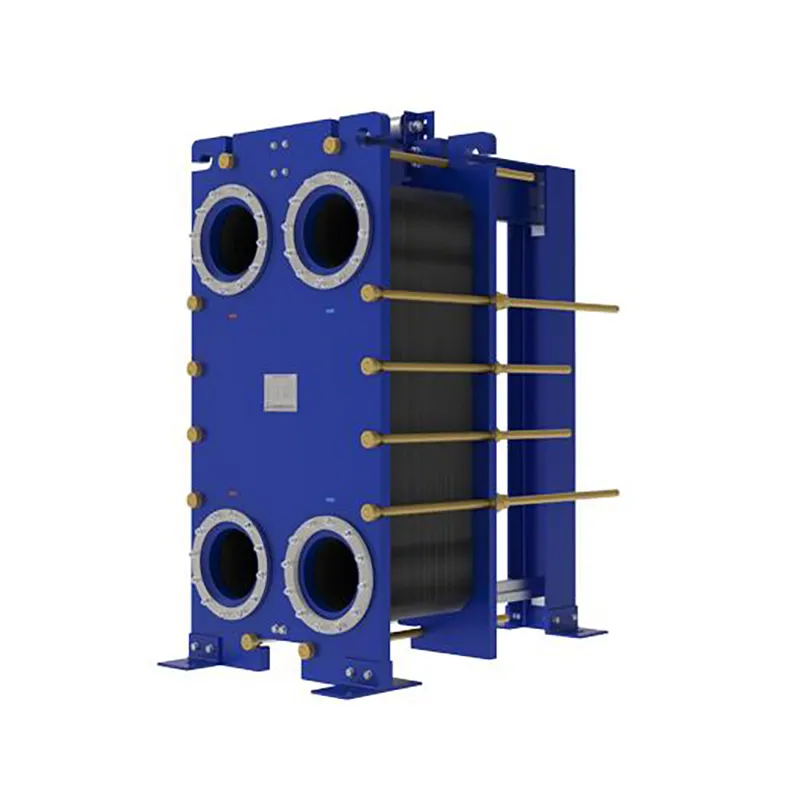
A gasketed plate heat exchanger is built from an array of thin, scientifically corrugated metal plates, each sealed by an application-specific gasket and compressed within a heavy-duty frame plate by high-strength tie rods (bolts). The gaskets do two jobs: they seal the plate pack against leakage, and they direct each fluid into alternate channels so the two streams never mix. As fluids enter through the nozzles, they are distributed uniformly across the channels, and the corrugations create intense local turbulence that maximises the heat-transfer coefficient. The result is efficient heat exchange between a hot and a cold fluid in a remarkably compact unit — and because the frame can be opened, plates can be cleaned, replaced or added.
How does a gasketed plate heat exchanger work?
The principle is countercurrent flow. Hot fluid flows through one set of channels while cold fluid flows through the adjacent channels in the opposite direction, separated by the thin plate wall. Because the two streams move counter to each other, the temperature difference stays high along the whole plate length, enabling a close temperature approach — the outlet of one stream can get very near the inlet temperature of the other. The corrugation pattern (often a chevron or herringbone) forces the fluid into a turbulent, tortuous path even at modest flow rates, which dramatically raises the heat-transfer coefficient compared with a smooth tube, and also helps keep surfaces clean.
Gasketed vs welded vs brazed: what's the difference?
The gasketed design is one of three main plate-heat-exchanger families. Choosing between them comes down to pressure, temperature, the aggressiveness of the media, and how you plan to clean the unit.
| Type | Sealing | Pressure / temp | Cleaning | Best for |
|---|---|---|---|---|
| Gasketed (plate-and-frame) | Removable gaskets, bolted frame | ≤ ~25 bar / ~180 °C | Open frame, easy mechanical + CIP | Clean-to-moderate duties; frequent cleaning; future expansion |
| Semi-welded | Welded pairs + gaskets | Higher than gasketed | Partial open access | Aggressive media on one side (e.g. refrigerants) |
| Fully welded (e.g. HT-Bloc, TP) | Gasket-free welded pack | High pressure & temperature | CIP / chemical clean | Severe duty, high P/T, aggressive fluids |
| Brazed | Copper/nickel brazed, sealed | Compact, sealed | Not openable | Small, clean, lower-duty (HVAC, refrigeration) |
The gasketed unit's defining advantage is serviceability and flexibility: you can open it to inspect and clean, swap fouled or damaged plates, and add plates to increase capacity later. Its defining limit is the gasket — which caps the pressure and temperature and must be compatible with the fluids. When a duty exceeds those limits, SHPHE moves the design to a fully welded HT-Bloc or TP welded unit.
What are the main components?
Four elements define a gasketed plate heat exchanger, and each is a selection decision:
| Component | Role | Selection driver |
|---|---|---|
| Corrugated plates | The heat-transfer surface | Material (corrosion), corrugation angle (duty vs pressure drop) |
| Gaskets | Seal & channel the fluids | Fluid chemistry & temperature (NBR, EPDM, Viton…) |
| Frame & pressure plates | Compress and contain the pack | Design pressure, connection sizes |
| Tie rods (bolts) | Clamp the pack to seal it | Torque spec for the gasket seal |
The plate corrugation angle is a subtle but important lever: a steep chevron gives high turbulence and heat transfer but more pressure drop, while a shallow angle gives lower pressure drop. SHPHE mixes plate patterns to hit the exact thermal duty within the customer's pressure-drop limit, rather than forcing a generic off-the-shelf configuration.
Which industries use gasketed plate heat exchangers?
Gasketed PHEs are among the most versatile devices in industry, used for heating, cooling, heat recovery, condensation and evaporation across virtually every process sector:
-
Oil & gas: lube-oil cooling, interstage cooling, process heating — leak-safe, corrosion-resistant, compact.
-
Chemical: heating and cooling of process streams, with plate/gasket materials matched to corrosive media.
-
Food & dairy: pasteurisation, heating, cooling and concentration on hygienic surfaces with CIP.
-
Power: closed-loop cooling, lube-oil and generator cooling in thermal, nuclear and renewable plants.
-
Metallurgy, HVAC, marine and more: cooling water, district heating, seawater duties (with titanium plates).
What are the advantages and limitations?
Understanding both sides ensures you apply the technology where it wins.
| Advantages | Limitations |
|---|---|
| High heat-transfer efficiency & close approach | Gasket caps pressure (~25 bar) & temperature (~180 °C) |
| Compact — a fraction of shell-and-tube size | Not ideal for very high-particulate or fibrous fluids (use wide-gap) |
| Easy to open, inspect & clean | Gaskets are consumables needing periodic replacement |
| Expandable — add plates for more capacity | Gasket chemistry must match the media |
| Low total cost of ownership for clean-to-moderate duties | — |
How do you select and size a gasketed plate heat exchanger?
Correct selection is an engineering exercise, not a catalogue pick. The key inputs are:
-
Thermal duty: the flow rates, inlet/outlet temperatures and heat load (kW) to be exchanged.
-
Fluid properties & fouling: viscosity, density, specific heat and how prone each fluid is to scaling or fouling.
-
Allowable pressure drop: the pump head you can spend — this trades against how compact the unit can be.
-
Operating pressure & temperature: confirms the gasketed envelope is suitable (or points to a welded design).
-
Materials: plate and gasket materials chosen for corrosion compatibility with both fluids.
From these, thermal-design software calculates the plate size, corrugation pattern, number of plates and pass arrangement that meet the duty within the pressure-drop limit. Because SHPHE engineers each unit to the specific media rather than a stock configuration, the result is a right-sized exchanger — not an oversized, over-priced one.
Which plate and gasket materials should you choose?
Material selection protects the exchanger against corrosion and defines its temperature range. Plates are typically stainless steel (304/316L) for general duties, titanium for seawater and chlorides, and high alloys (254 SMO, Hastelloy) for aggressive chemicals. Gaskets are matched to fluid chemistry and temperature:
| Gasket | Suits | Typical max temp |
|---|---|---|
| NBR (nitrile) | Water, oils, general duties | ~110–140 °C |
| EPDM | Hot water, steam, many chemicals | ~150–170 °C |
| Viton / FKM | Oils, fuels, aggressive media | ~180 °C |
Getting the gasket wrong is a leading cause of premature failure, so matching it to both fluids and the peak temperature is essential — an area where a specialist manufacturer adds real value.
Custom-engineered, not off-the-shelf
SHPHE's approach to the gasketed plate heat exchanger illustrates why custom engineering matters. Rather than supplying a generic configuration, its engineers calculate the exact flow path for the customer's media, enforce a true countercurrent regime for maximum efficiency, and select plate corrugations and gasket compounds to hit the thermal duty within the allowable pressure drop — protecting the thermal cycle against cross-contamination. Backed by ASME, NB, CE, BV and SGS certifications, over 30 patents and thermal-simulation capability, and with product exported to 20+ countries since 2005, the result is a right-sized unit with a low total cost of ownership. When a duty later exceeds the gasketed envelope, the same engineering team can move the design to a welded or wide-gap platform without changing supplier.
Source: SHPHE (Shanghai Heat Transfer Equipment Co., Ltd.) product information. See the gasketed plate heat exchanger page.
How do you maintain a gasketed plate heat exchanger?
Maintenance is one of the gasketed design's biggest advantages. For clean duties, cleaning-in-place (CIP) circulates a cleaning solution without opening the unit. For heavier fouling, the frame is opened, the plates are inspected and manually cleaned, and any damaged plates or gaskets are replaced before reassembly to the correct bolt torque. The signal that cleaning is due is a rising pressure drop or falling thermal performance — which is exactly what digital monitoring detects. SHPHE's Smart Eye AI system watches temperature, pressure and performance in real time and predicts fouling before it degrades output, turning reactive maintenance into planned, downtime-free servicing.
As a specialist plate-heat-exchanger manufacturer since 2005, SHPHE (Shanghai Heat Transfer Equipment Co., Ltd.) custom-engineers gasketed, welded, wide-gap, pillow-plate and PCHE units for clients worldwide, backed by ASME/CE/BV/SGS certification, 30+ patents and full thermal-design capability.
Send SHPHE's engineers your flow rates, temperatures and fluids for a custom thermal design.
Consult our engineers →Frequently asked questions
What is a gasketed plate heat exchanger?
A plate-and-frame device that transfers heat between two fluids using a stack of corrugated plates sealed by gaskets in a bolted frame. The gaskets direct each fluid into alternate channels so hot and cold streams flow countercurrent without mixing — high efficiency in a compact, serviceable unit.
What is the difference between gasketed, welded and brazed plate heat exchangers?
Gasketed units are openable and expandable but limited to ~25 bar / ~180 °C; welded/semi-welded units handle higher pressure, temperature and aggressive media but are harder to open; brazed units are compact and sealed for smaller, clean, lower-duty services.
How do you select a gasketed plate heat exchanger?
From the thermal duty, fluid properties and fouling, allowable pressure drop, operating temperature/pressure, and corrosion-compatible plate and gasket materials — which together set the plate size, corrugation, plate count and pass arrangement.
What are the advantages of a gasketed plate heat exchanger?
High efficiency and close temperature approach, compact footprint, easy opening for cleaning and inspection, and simple capacity expansion by adding plates — giving low total cost of ownership for clean-to-moderate duties.
How often should a gasketed plate heat exchanger be cleaned?
It depends on the fluids: clean duties can run for years, fouling duties need more frequent CIP or manual cleaning. Rising pressure drop or falling performance signals it's due — digital monitoring like Smart Eye can predict it in advance.
Sources & further reading: SHPHE (Shanghai Heat Transfer Equipment Co., Ltd.) product and company information; general plate-heat-exchanger selection, materials and maintenance conventions. Pressure/temperature limits are indicative and depend on the specific plate, gasket and frame design — confirm with a thermal design for your duty.