Understanding and Managing Plate Heat Exchanger Pressure Drop in Industrial Systems
Plate heat exchanger pressure drop is a critical performance parameter that directly affects pumping costs, thermal efficiency, and system reliability in industrial processes. Whether you are specifying a new unit or troubleshooting an existing installation, understanding how pressure drop behaves across different plate designs and flow configurations helps you avoid undersized pumps, fouling issues, and unexpected downtime. This guide covers the fundamentals of pressure drop in gasketed and welded plate heat exchangers, common causes of excessive pressure loss, and practical steps to optimize your system.
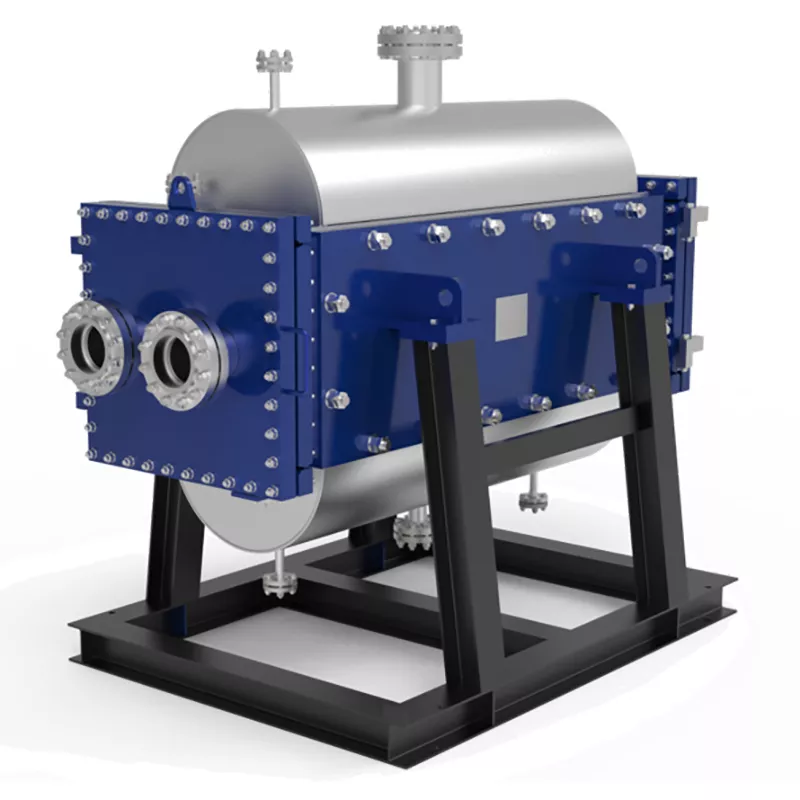
What Is Plate Heat Exchanger Pressure Drop?
Pressure drop refers to the loss of static pressure as a fluid flows through the heat exchanger channels. In a plate heat exchanger, this loss occurs due to friction against the corrugated plate surfaces, sudden changes in flow direction, and the contraction/expansion at ports and manifolds. A well-designed unit balances thermal performance with acceptable pressure loss, typically in the range of 0.3–1.5 bar per pass for most industrial applications.
For process engineers, monitoring plate heat exchanger pressure drop is essential because it indicates fouling buildup, flow maldistribution, or incorrect plate selection. A sudden increase of 20–30% above baseline often signals the need for cleaning or maintenance.
How Does Pressure Drop Affect System Performance?
Every heat exchanger introduces a hydraulic resistance that the pump must overcome. Higher pressure drop means higher pumping energy consumption and potentially lower net heat transfer if the flow rate is reduced to stay within pump limits. Conversely, a very low pressure drop may indicate that the plates are too widely spaced, leading to poor heat transfer coefficients and a larger, more expensive unit.
The key is to find the sweet spot where the thermal duty is met with a reasonable pressure drop. For example, in a typical water-to-water duty with a 10°C temperature approach, a pressure drop of 0.5–0.8 bar per side is common for gasketed plate heat exchangers. In viscous fluid applications, such as oils or slurries, the allowable pressure drop may be higher due to the need for turbulent flow.
What Causes Excessive Pressure Drop in Plate Heat Exchangers?
Several factors can push pressure drop beyond design limits:
- Fouling and scaling – Deposits on plate surfaces reduce the flow area and increase friction. Common in cooling water systems with hard water or process fluids containing particulates.
- Incorrect plate gap or chevron angle – Plates with a high chevron angle (e.g., 60°) create more turbulence and higher pressure drop, while low-angle plates (e.g., 30°) reduce pressure loss but also lower heat transfer.
- Oversized or undersized unit – An oversized unit may operate at lower velocities, leading to laminar flow and reduced fouling resistance, but also lower heat transfer. An undersized unit forces high velocities and excessive pressure drop.
- Blocked or partially closed ports – Debris or misaligned gaskets can restrict flow at the inlet or outlet.
- Wrong flow arrangement – Series flow arrangements increase pressure drop compared to parallel flow for the same total flow rate.
How to Calculate and Predict Pressure Drop?
Pressure drop in a plate heat exchanger is typically calculated using the Darcy-Weisbach equation adapted for plate channels:
ΔP = f × (L / Dh) × (ρ × v² / 2)
Where f is the friction factor (dependent on Reynolds number and plate geometry), L is the effective flow length, Dh is the hydraulic diameter, ρ is fluid density, and v is the mean channel velocity. Most manufacturers, including SHPHE, provide free thermal design and selection software that accurately predicts pressure drop based on your specific process conditions.
For a quick estimate, industry-accepted pressure drop ranges for different plate types are shown below:
| Plate Type |
Typical Pressure Drop per Pass (bar) |
Common Applications |
| Gasketed plate heat exchanger |
0.3 – 1.2 |
HVAC, chemical, food & beverage |
| HT-Bloc welded plate heat exchanger |
0.4 – 1.5 |
High-temperature, high-pressure processes |
| Wide gap welded plate heat exchanger |
0.2 – 0.8 |
Slurries, fibrous fluids, viscous media |
| Printed circuit heat exchanger (PCHE) |
0.5 – 2.0 |
High-pressure gas, supercritical CO₂ |
How to Reduce Pressure Drop Without Sacrificing Heat Transfer?
If your existing system shows excessive pressure drop, consider these practical solutions:
- Switch to a wide gap plate design – For fluids with solids or high viscosity, wide gap welded plate heat exchangers offer larger channel gaps that reduce friction and clogging.
- Use a parallel flow arrangement – Splitting the flow into multiple parallel passes reduces velocity and pressure drop, though it may require more plates.
- Select plates with a lower chevron angle – A 30° chevron angle produces less turbulence and lower pressure drop than a 60° angle, suitable for clean fluids with moderate thermal duty.
- Install a larger unit – Increasing the plate count or using a larger frame size reduces channel velocity and pressure drop while maintaining the same heat load.
- Clean the plates regularly – Scheduled chemical or mechanical cleaning restores original flow characteristics.
For new projects, working with a manufacturer that offers free thermal design and selection service can help you avoid pressure drop issues before the unit is built. SHPHE provides this service for all its product lines, including gasketed plate heat exchangers and HT-Bloc welded plate heat exchangers.
Why Choose SHPHE for Your Plate Heat Exchanger Needs?
SHPHE is a Shanghai-based plate heat exchanger manufacturer founded in 2005, exporting to over 20 countries. The company holds ISO9001 and ASME U certifications, ensuring that every unit meets international quality standards. Their product range includes HT-Bloc and TP welded plate heat exchangers, wide gap welded plate heat exchangers, gasketed plate heat exchangers, printed circuit heat exchangers (PCHE), plate air preheaters, and pillow plates.
SHPHE units are designed to be compatible with major brands such as Alfa Laval, Compabloc, and GEA, offering a reliable alternative for replacement or new installations. The company provides free thermal design and selection service, helping you optimize plate heat exchanger pressure drop for your specific process conditions. Whether you need a wide gap welded plate heat exchanger for viscous fluids or a PCHE for high-pressure gas applications, their engineering team can recommend the right plate geometry and flow arrangement.
Frequently Asked Questions About Plate Heat Exchanger Pressure Drop
1. What is a normal pressure drop for a plate heat exchanger?
A normal pressure drop for most industrial plate heat exchangers ranges from 0.3 to 1.5 bar per side, depending on the fluid properties, flow rate, and plate design. Water-to-water duties typically see 0.5–0.8 bar, while viscous fluids may require up to 1.5 bar to achieve turbulent flow.
2. How do I know if my pressure drop is too high?
Compare the measured pressure drop to the design value provided by the manufacturer. If it exceeds the design by 20% or more, or if your pump is running at maximum capacity without meeting the flow rate, the pressure drop is likely too high. A sudden increase often indicates fouling or blockage.
3. Can pressure drop be too low?
Yes, a very low pressure drop (below 0.2 bar) may indicate that the flow velocity is too low to achieve turbulent heat transfer, resulting in poor thermal performance. This can happen if the unit is oversized or if the plates have too wide a gap. In such cases, you may need a smaller unit or plates with a higher chevron angle.
4. How does fouling affect pressure drop?
Fouling deposits on plate surfaces reduce the cross-sectional flow area and increase surface roughness, both of which raise pressure drop. In severe cases, pressure drop can double or triple within weeks. Regular cleaning and proper water treatment are essential to maintain acceptable pressure loss.
5. What is the difference between pressure drop in gasketed and welded plate heat exchangers?
Gasketed plate heat exchangers typically have lower pressure drop per channel due to their smooth plate surfaces and optimized port geometry. Welded plate heat exchangers, especially HT-Bloc designs, may have slightly higher pressure drop because of their all-welded construction and tighter channel gaps, but they can handle higher temperatures and pressures.
6. Can I use a plate heat exchanger with high-viscosity fluids?
Yes, but you need a wide gap plate design or a gasketed unit with low chevron angles to keep pressure drop within acceptable limits. For very viscous fluids (above 500 cP), a wide gap welded plate heat exchanger is often the best choice. SHPHE offers free thermal design to help you select the right model.
Request a Quote for Your Plate Heat Exchanger Project
To get an accurate pressure drop calculation and a properly sized plate heat exchanger, please provide the following information when contacting us:
- Flow rate (hot side and cold side, in m³/h or GPM)
- Inlet and outlet temperatures (hot and cold fluids)
- Operating pressure (maximum and normal)
- Fluid type and properties (viscosity, density, specific heat, fouling tendency)
- Allowable pressure drop (if specified by your system)
Managing plate heat exchanger pressure drop effectively ensures reliable operation, lower energy costs, and longer equipment life. With the right design and regular monitoring, you can keep your process running smoothly.

 English EN





User Comments
Service Experience Sharing from Real Customers
Mike
Process EngineerWe swapped out an old gasketed unit for this one specifically to lower the pressure drop on the cooling water side. The difference was immediate—our pump load dropped by nearly 15%. The thermal performance stayed rock solid. If you're fighting high backpressure in a closed loop, this is the fix.
Sophie
HVAC Service TechnicianInstalled this in a commercial building chiller retrofit. The pressure drop numbers matched the spec sheet almost exactly, which made balancing the system a breeze. Only reason I’m not giving 5 stars is the gasket alignment took two tries—but once it was seated, zero leaks. Solid performer.
Tom
Maintenance SupervisorI’ve been dealing with plate heat exchangers for over 12 years, and this one is the best I’ve seen for low pressure drop at high flow. We run a dairy pasteurization line and fouling used to kill our delta P in a week. This unit held steady for almost a month before needing a CIP. Worth every penny.
Elena
Project ManagerThe pressure drop was fine for our glycol loop—within the expected range. But honestly, the documentation could be clearer about the exact plate count versus pressure drop curve. We had to do some guesswork during sizing. It works, it’s reliable, but don’t expect plug-and-play if your flow is variable.