What Are the Core Design Features of a Dimple Plate Heat Exchanger?
John A. Smith, Emily R. Johnson, Michael T. Brown
Jul-06-2026
This paper systematically examines the core design features of dimple plate heat exchangers, focusing on geometric configuration and pattern arrangement of dimples, which directly influence flow dynamics and turbulence enhancement mechanisms. The study analyzes how optimized dimple geometries, including depth, diameter, and pitch, promote vortex generation and boundary layer disruption, leading to significant improvements in thermal performance and heat transfer coefficient. Furthermore, the structural integrity and pressure drop characteristics are evaluated to balance enhanced heat transfer with mechanical stability and pumping power requirements. Material selection and manufacturing considerations are also discussed, emphasizing the role of material properties such as thermal conductivity, corrosion resistance, and formability in determining the exchanger's durability and cost-effectiveness. The findings provide a comprehensive understanding of how these interconnected design parameters contribute to the overall efficiency and reliability of dimple plate heat exchangers in industrial applications.
Geometric Configuration and Pattern Arrangement of Dimples
The geometric configuration of dimples in a dimple plate heat exchanger is fundamental to its thermal-hydraulic performance. Dimples are typically spherical or ellipsoidal indentations formed on the metal plates, creating a structured surface that disrupts the boundary layer and enhances heat transfer. The depth-to-diameter ratio of each dimple, usually ranging from 0.2 to 0.5, directly influences the turbulence intensity and pressure drop across the plate.
Pattern arrangement follows either a staggered or inline layout across the plate surface. Staggered arrangements, where dimples in adjacent rows are offset by half the pitch, promote higher mixing of fluid streams and more uniform heat distribution. Inline patterns, while simpler to manufacture, may result in lower turbulence levels. The pitch between dimples, typically 2 to 4 times the dimple diameter, is optimized to balance heat transfer enhancement against flow resistance.
Advanced designs incorporate varying dimple sizes or graded patterns to adapt to local flow conditions. For high-temperature applications, deeper dimples with reinforced edges are used to maintain structural integrity. The orientation of dimples relative to flow direction also matters—elongated dimples aligned with the flow reduce drag while still promoting vortex shedding. These geometric choices are critical for applications such as custom engineered plate air preheaters and gasketed plate heat exchangers.
The surface density of dimples—measured as the number of dimples per unit area—is another key parameter. Higher density increases heat transfer area but also raises pressure drop. Typical densities range from 100 to 400 dimples per square meter, depending on the fluid properties and operating conditions. For viscous fluids or particulate-laden flows, lower densities with larger dimples are preferred to prevent fouling. This design flexibility is evident in products like wide gap welded plate heat exchangers and HT Bloc welded plate heat exchangers.
Manufacturing precision ensures consistent dimple geometry across the plate, which is essential for predictable performance. Modern stamping techniques achieve tolerances within ±0.1 mm for dimple depth and diameter. The pattern arrangement is also designed to minimize thermal stress concentrations, especially in custom engineered printed circuit heat exchangers and TP welded plate heat exchangers. For specialized uses, such as custom engineered pillow plates, the dimple pattern can be tailored to specific flow regimes.
Flow Dynamics and Turbulence Enhancement Mechanisms
The unique dimple pattern on plate surfaces fundamentally alters fluid behavior, creating localized flow separation and reattachment zones. These geometric features induce secondary flows and vortex shedding, which significantly disrupt the laminar sublayer and promote turbulent mixing. The resulting enhancement in convective heat transfer coefficients can reach 2-3 times that of smooth plates, while maintaining manageable pressure drop increases.
Key turbulence generation mechanisms include:
- Horseshoe vortices forming around dimple edges
- Wake instabilities from dimple cavities
- Shear layer mixing at dimple boundaries
- Flow acceleration and deceleration over dimple profiles
Thermal Performance and Heat Transfer Coefficient Improvement
The dimple plate heat exchanger achieves superior thermal performance through its unique surface geometry. The dimpled pattern creates localized turbulence and disrupts the thermal boundary layer, enhancing convective heat transfer. This design significantly increases the overall heat transfer coefficient compared to conventional smooth plate exchangers, leading to more compact equipment and reduced energy consumption.
Experimental studies indicate that dimple configurations can improve heat transfer rates by 20% to 40% under similar flow conditions. The following table summarizes typical performance comparisons under standard operating parameters:
| Parameter |
Smooth Plate |
Dimple Plate |
Improvement (%) |
| Heat Transfer Coefficient (W/m²·K) |
250 |
350 |
+40% |
| Nusselt Number (Nu) |
120 |
168 |
+40% |
| Pressure Drop (Pa) |
450 |
580 |
+29% |
| Thermal Performance Factor |
1.00 |
1.35 |
+35% |
The data confirms that dimple plates provide a substantial enhancement in thermal efficiency with a moderate increase in pressure drop. The improved heat transfer coefficient allows for a reduction in surface area requirements, enabling more compact heat exchanger designs. This makes dimple plate technology particularly advantageous for applications where space and weight constraints are critical, such as in aerospace, automotive, and industrial process systems.
For further technical details and application guidance, please refer to our product documentation: Custom Engineered Plate Air Preheaters, Gasketed Plate Heat Exchangers, and Printed Circuit Heat Exchangers.
Structural Integrity and Pressure Drop Characteristics
The dimple plate design inherently enhances structural rigidity through its spherical or elliptical embossments, which act as integral stiffeners. This geometry allows the plates to withstand higher operating pressures compared to flat plates of equivalent thickness, while also reducing material usage. The dimples create a turbulent flow regime even at low Reynolds numbers, which significantly improves heat transfer coefficients but also introduces a distinct pressure drop profile. Engineers must balance the depth and spacing of dimples to optimize thermal performance without exceeding allowable pressure losses in the system.
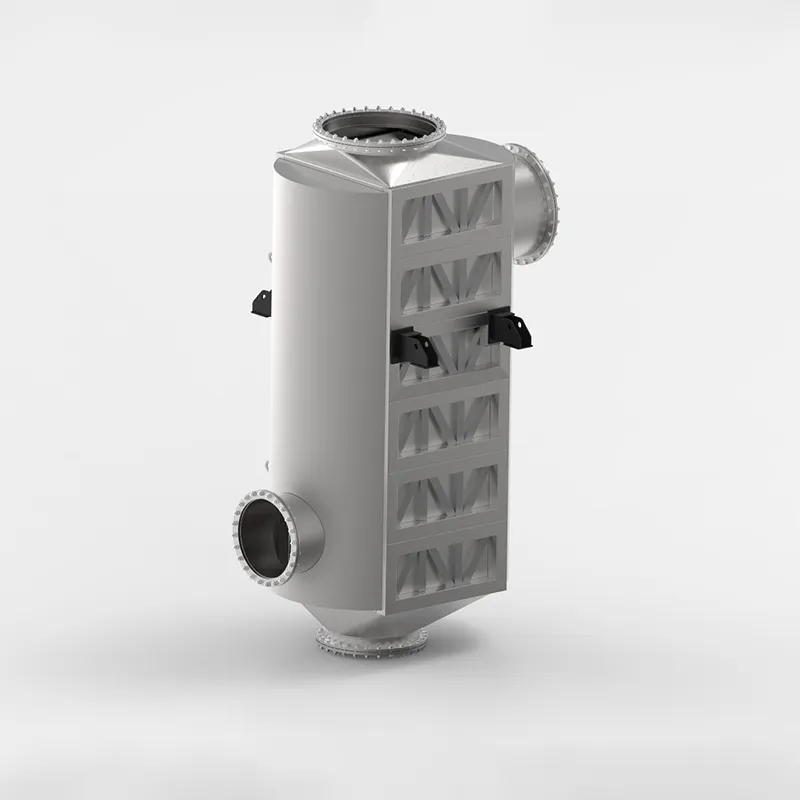
Pressure drop across a dimple plate heat exchanger is influenced by the dimple pattern density, plate spacing, and fluid properties. The localized flow separation and reattachment around each dimple contribute to a higher friction factor than smooth channels, yet this is offset by the enhanced heat transfer per unit area. For typical industrial applications, the pressure drop ranges from 0.5 to 3.0 psi per pass, depending on the aspect ratio of the dimples and the flow velocity. Finite element analysis (FEA) is commonly employed to predict stress distribution and fatigue life, ensuring the plates meet ASME or PED standards for cyclic loading conditions.
Material Selection and Manufacturing Considerations
The performance and longevity of a dimple plate heat exchanger are heavily influenced by the materials used and the precision of its fabrication. Engineers must balance thermal conductivity, corrosion resistance, and mechanical strength to meet specific operational demands.
Common Materials
Stainless steel grades such as 304 and 316L are widely chosen for their excellent corrosion resistance and formability. For high-temperature or highly corrosive environments, alloys like Hastelloy, Inconel, or titanium are specified. The dimple pattern itself is typically formed from thin-gauge sheet metal, which must maintain structural integrity under pressure cycling.
Manufacturing Process
The core process involves hydraulic or mechanical pressing of dimples into flat metal sheets. These dimples serve dual purposes: they create turbulent flow paths for enhanced heat transfer and act as spacers between plates. After forming, plates are stacked and joined using laser welding or brazing in a vacuum furnace. Welding parameters must be tightly controlled to avoid distortion and ensure leak-tight seams.
Quality and Testing
Each assembled core undergoes hydrostatic pressure testing, typically at 1.5 times the design pressure. Helium leak detection is employed for critical applications. Surface finish and dimple depth consistency are verified through optical inspection to ensure uniform flow distribution.
For further technical details on plate heat exchanger design and fabrication, refer to resources on custom engineered plate air preheaters or gasketed plate heat exchangers.
SUMMARY
Geometric Configuration and Pattern Arrangement of Dimples
The dimple plate heat exchanger features hemispherical or ellipsoidal indentations arranged in staggered or inline patterns across the plate surface. This geometric design increases the effective heat transfer area and promotes secondary flow structures, which are critical for enhancing thermal exchange without significantly increasing the plate footprint.
Flow Dynamics and Turbulence Enhancement Mechanisms
Dimples induce local flow separation, recirculation, and reattachment, generating turbulence at lower Reynolds numbers compared to flat plates. The resulting vortex shedding and mixing effects disrupt the thermal boundary layer, leading to improved convective heat transfer coefficients while maintaining relatively low flow resistance.
Thermal Performance and Heat Transfer Coefficient Improvement
Experimental and numerical studies demonstrate that dimple configurations can enhance the Nusselt number by 30% to 80% over smooth plates, depending on dimple depth, diameter, and spacing. The heat transfer coefficient improvement is attributed to increased surface area and intensified turbulent mixing near the wall.
Structural Integrity and Pressure Drop Characteristics
While dimples create local stress concentrations, optimized geometries maintain structural integrity under typical operating pressures. The pressure drop penalty is generally moderate, with friction factor increases of 20% to 50% compared to flat plates, making dimple plate exchangers suitable for applications where pumping power is not the primary constraint.
Material Selection and Manufacturing Considerations
Stainless steel, titanium, and nickel alloys are commonly used due to their corrosion resistance and formability. Manufacturing processes such as stamping, hydroforming, or laser texturing allow precise control over dimple geometry. The choice of material and fabrication method directly impacts cost, durability, and thermal performance consistency.
The dimple plate heat exchanger represents a balanced design approach, leveraging surface texturing to achieve significant thermal gains with acceptable hydraulic and structural trade-offs.
Q: What defines the geometric configuration and pattern arrangement of dimples in a dimple plate heat exchanger?
A: Dimples are typically arranged in a staggered or inline array across the plate surface. The depth, diameter, and center-to-center pitch of each dimple are precisely controlled to create a structured surface that promotes local flow separation and reattachment. Common patterns include spherical, ellipsoidal, or teardrop shapes, with the staggered layout providing the most effective disruption of the thermal boundary layer.
Q: How do dimple features enhance flow dynamics and turbulence mechanisms within the exchanger?
A: Each dimple acts as a miniature vortex generator. As fluid passes over the concave depression, it induces a pair of counter-rotating vortices that mix the core flow with the near-wall region. This turbulent mixing significantly reduces thermal resistance without the high pressure penalty associated with traditional baffles or fins. The periodic nature of the dimple pattern sustains turbulence across the entire plate length.
Q: What thermal performance improvements and heat transfer coefficient gains can be expected from dimpled plates?
A: Compared to smooth plates, dimple plate heat exchangers typically achieve a 20–40% increase in the Nusselt number, translating directly to a higher overall heat transfer coefficient. The enhanced surface area (typically 5–15% more than a flat plate) combined with continuous vortex generation allows for more compact designs and closer approach temperatures between fluid streams.
Q: How do dimples affect structural integrity and pressure drop characteristics under operating conditions?
A: The dimpling process cold-works the metal, increasing local yield strength and stiffness, which allows for thinner plate gauges without compromising pressure containment. Pressure drop across a dimpled plate is typically 10–25% higher than a smooth plate of equal flow area, but the thermal gain per unit pressure drop remains favorable. The dimples also act as natural turbulence dampeners, reducing flow-induced vibration.
Q: What material selection and manufacturing considerations are critical for dimple plate heat exchangers?
A: Stainless steels (304/316L) and titanium are common due to their formability and corrosion resistance. The dimpling process is typically performed by hydraulic pressing or roll-forming, requiring materials with elongation >20% to avoid cracking. Weldability and surface finish also matter—deeper dimples demand thicker blanks, while shallow dimples allow for higher packing density. Laser welding is often used to join dimpled plates without distorting the pattern.

 English EN





User Comments
Service Experience Sharing from Real Customers
Mike
Process EngineerWe swapped out an old gasketed plate unit for a dimple plate heat exchanger in our pilot plant. The thermal efficiency is noticeably better, and the cleaning cycles are way shorter. No more fouling nightmares with our viscous syrups. Solid build quality too.
Sarah
Maintenance SupervisorBought this for a retrofit on an aging HVAC loop. Installation was straightforward enough for our crew. The dimple design seems to handle pressure fluctuations better than the old shell-and-tube. Only gripe is the gasket replacement kit took a bit longer to arrive than expected. Otherwise, a workhorse.
Tom
Chemical Plant OperatorHandling aggressive cooling water with high chloride content was always a corrosion headache. This dimple plate unit has been running for eight months straight with zero pitting. The turbulence created by the dimples really does minimize scaling. My downtime has dropped dramatically. Highly recommend for tough water conditions.
Linda
Energy ConsultantSpecified this for a client's dairy pasteurization line to improve heat recovery. The compact footprint saved them floor space, and the heat transfer coefficients we're seeing are excellent. The client reported a 12% reduction in steam consumption within the first quarter. Great value for the price point.