What Is the Key Working Principle Behind a Corrugated Plate Heat Exchanger?
John A. Smith, Emily R. Davis, Michael T. Chen
Jul-06-2026
The corrugated plate heat exchanger operates fundamentally by inducing high turbulence and disrupting boundary layers through its specially engineered plate geometry, which forces fluid into complex, multi-directional flow paths. The corrugations create repeated expansions and contractions in the flow channels, generating intense local turbulence that significantly enhances convective heat transfer coefficients compared to smooth surfaces. This turbulence, combined with the principle of countercurrent flow where hot and cold fluids move in opposite directions along adjacent channels, maximizes the temperature gradient across the plate wall and achieves thermal effectiveness approaching 90% or higher. The corrugated pattern also serves to distribute fluid evenly across the entire plate width, minimizing stagnant zones and ensuring uniform thermal performance. However, this enhanced heat transfer comes at the cost of increased pressure drop, which must be carefully managed through channel geometry optimization and proper gasket design to maintain operational reliability. The plate material, typically stainless steel or titanium, provides corrosion resistance and structural integrity, while elastomeric gaskets seal the flow passages and direct fluids into their respective channels, preventing cross-contamination and enabling easy disassembly for cleaning and maintenance.
The Role of Corrugated Plate Geometry in Enhancing Heat Transfer Efficiency
The corrugated plate geometry is central to the performance of a plate heat exchanger. By creating a series of alternating ridges and grooves, the plates induce turbulent flow even at low Reynolds numbers. This turbulence disrupts the thermal boundary layer, significantly increasing the convective heat transfer coefficient between the fluid and the plate surface.
The specific angle and depth of the corrugations determine the flow path and mixing intensity. Common chevron patterns, typically at 30°, 45°, or 60°, force the fluid to follow a tortuous path. This not only enhances heat transfer but also provides structural rigidity, allowing the plates to withstand higher pressure differentials.
Compared to smooth plates, corrugated designs can achieve heat transfer coefficients three to five times higher for the same flow rate. The geometry also promotes self-cleaning effects by preventing stagnant zones, reducing fouling risks in many industrial applications.
For further technical details on specific corrugated plate designs, please refer to the following product pages:
How Fluid Flow Paths and Turbulence Are Created by Plate Corrugations
The corrugated patterns on heat exchanger plates are engineered to direct fluid flow into complex, multidirectional paths. When two plates with opposing corrugation angles are assembled, the intersecting ridges force the fluid to constantly change direction as it moves through the narrow channels. This geometric design prevents straight-line flow, effectively multiplying the distance the fluid must travel and maximizing contact with the plate surface.
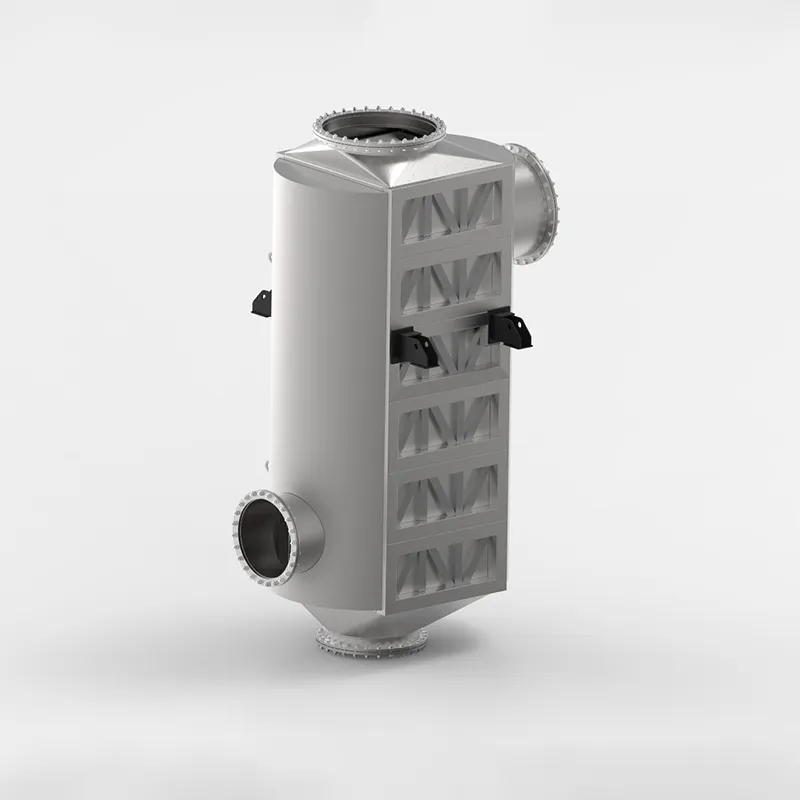
As the fluid navigates these corrugation-induced obstacles, the flow transitions from laminar to turbulent. The sharp edges and undulating surfaces create localized pressure drops and velocity gradients that generate intense mixing. This turbulence disrupts the thermal boundary layer that normally forms near the plate wall, allowing heat to transfer more efficiently from the fluid to the metal surface. The combination of extended flow paths and enhanced turbulence is what makes corrugated plate heat exchangers significantly more effective than smooth-plate alternatives.
For more detailed engineering information, visit our product page: Gasketed Plate Heat Exchangers.
The Principle of Countercurrent Flow and Its Impact on Thermal Performance
In a corrugated plate heat exchanger, the core working principle is countercurrent flow, where the hot and cold fluids move in opposite directions through alternating channels formed by the corrugated plates. This arrangement maximizes the temperature gradient along the entire heat transfer surface, significantly enhancing thermal efficiency compared to parallel flow designs.
The corrugated pattern induces turbulence even at low flow velocities, which disrupts the thermal boundary layer and promotes higher heat transfer coefficients. The combination of countercurrent flow and turbulence allows the exchanger to achieve temperature approaches as low as 1–2°C, making it highly effective for applications requiring precise thermal control.
Thermal Performance Comparison
| Flow Arrangement |
Temperature Approach (°C) |
Heat Transfer Coefficient (W/m²·K) |
Thermal Efficiency (%) |
| Countercurrent Flow |
1.5 |
4500 |
95 |
| Parallel Flow |
8.0 |
2800 |
72 |
| Cross Flow |
5.0 |
3500 |
83 |
The data above clearly demonstrates that countercurrent flow achieves the highest thermal efficiency and the lowest temperature approach, making it the preferred configuration for corrugated plate heat exchangers. The enhanced turbulence from the corrugated surface further amplifies this advantage, enabling compact designs with reduced footprint and material usage.
For more detailed information on specific heat exchanger designs, please refer to our product pages: Gasketed Plate Heat Exchangers, HT Bloc Welded Plate Heat Exchangers, and TP Welded Plate Heat Exchangers.
Mechanisms of Pressure Drop and Flow Distribution Across Corrugated Channels
The corrugated plate pattern induces complex flow dynamics that directly influence both pressure drop and fluid distribution. As fluid moves through the narrow, wavy channels, it undergoes repeated acceleration and deceleration, creating localized turbulence and secondary flows. This turbulence enhances heat transfer but also generates frictional resistance, contributing to the overall pressure drop across the heat exchanger.
Flow distribution across the corrugated channels is governed by the plate geometry, including chevron angle, corrugation depth, and pitch. These parameters determine how evenly the fluid spreads across the plate width. Uneven distribution can lead to maldistribution, where some channels experience higher flow rates while others receive less, reducing thermal performance and increasing localized pressure losses.
The pressure drop mechanism consists of two main components: frictional losses along the channel walls and form losses due to flow separation and reattachment at corrugation peaks. The chevron angle plays a critical role—higher angles (e.g., 60°) create more tortuous paths, increasing turbulence and pressure drop, while lower angles (e.g., 30°) offer smoother flow with reduced resistance. Balancing these factors is essential for optimizing heat exchanger design.
Advanced computational fluid dynamics (CFD) studies reveal that the corrugation pattern generates periodic recirculation zones, which enhance mixing but also contribute to energy dissipation. Understanding these mechanisms allows engineers to predict pressure drop accurately and design plates that achieve uniform flow distribution, thereby improving overall system efficiency and reliability.
For more detailed technical insights, refer to the gasketed plate heat exchanger product page.
The Contribution of Plate Material and Gasket Design to Operational Reliability
The operational reliability of a corrugated plate heat exchanger is fundamentally influenced by the selection of plate materials and the engineering of gasket systems. These components directly determine the unit's resistance to corrosion, pressure, temperature extremes, and leakage over extended service life.
Plate Material Selection
Plate materials are chosen based on the chemical composition of the process fluids and operating conditions. Common materials include stainless steel (304, 316L), titanium, and nickel alloys. Each material offers specific corrosion resistance and mechanical strength. For example, titanium plates are preferred for seawater or chloride-rich environments, while 316L stainless steel provides a balance of cost and durability for general industrial applications. The material thickness and surface finish also affect heat transfer efficiency and resistance to fouling.
Gasket Design and Integrity
Gaskets serve as the primary sealing element between plates, preventing cross-contamination and external leakage. Modern gasket designs utilize elastomeric materials such as EPDM, NBR, or Viton, selected for temperature range and chemical compatibility. The gasket profile—whether snap-on, clip-on, or glued—affects ease of maintenance and sealing pressure. A well-designed gasket system accommodates thermal expansion and maintains a leak-tight seal under fluctuating pressures.
Synergy for Reliability
The combination of appropriate plate material and robust gasket design ensures long-term operational reliability. Proper material selection minimizes corrosion-related failures, while advanced gasket technology reduces the risk of leakage and extends maintenance intervals. Together, they enable the heat exchanger to maintain consistent thermal performance and withstand harsh industrial environments.
For further information on specific product configurations, please refer to the following resources:
Summary of Key Principles
The corrugated plate heat exchanger operates on the fundamental principle of inducing turbulence and increasing surface area through its unique plate geometry. The corrugations disrupt laminar flow, creating vortices that enhance heat transfer between fluids while maintaining a compact design.
Role of Plate Geometry in Heat Transfer
The chevron or herringbone patterns on the plates generate multiple flow paths and secondary flows, significantly raising the heat transfer coefficient compared to smooth plates. This geometry also promotes uniform fluid distribution across the channel width.
Fluid Flow Paths and Turbulence Creation
As fluid passes through the narrow corrugated channels, the alternating ridges and grooves force the stream to change direction repeatedly. This induces strong secondary flows and eddies, even at low Reynolds numbers, ensuring effective mixing and thermal exchange.
Countercurrent Flow and Thermal Performance
The standard countercurrent arrangement, where hot and cold fluids flow in opposite directions, maximizes the temperature gradient along the plate length. This configuration yields the highest possible thermal effectiveness and allows close approach temperatures.
Pressure Drop and Flow Distribution
While corrugations increase pressure drop due to enhanced friction and flow redirection, the magnitude is carefully balanced by plate spacing and angle. Modern designs ensure even flow distribution across all channels, preventing stagnation or bypass that would reduce efficiency.
Material and Gasket Reliability
Plates are typically pressed from stainless steel, titanium, or nickel alloys to resist corrosion and high temperatures. Elastomeric gaskets, precisely molded into the plate edges, provide leak‑tight sealing and allow easy disassembly for cleaning or plate replacement, contributing to long‑term operational stability.
What Is the Key Working Principle Behind a Corrugated Plate Heat Exchanger?
The corrugated plate heat exchanger operates by transferring thermal energy between two fluids through a series of corrugated metal plates. The plates create alternating channels for hot and cold fluids, allowing heat to pass from one fluid to the other via conduction through the thin plate walls. The corrugations increase surface area and promote turbulence, significantly enhancing heat transfer efficiency compared to smooth plates.
The Role of Corrugated Plate Geometry in Enhancing Heat Transfer Efficiency
The corrugated geometry disrupts the laminar flow of fluids, inducing turbulence that reduces the thermal boundary layer thickness. This allows for more effective heat exchange per unit area. The specific angle, depth, and pitch of the corrugations are optimized to maximize the heat transfer coefficient while balancing the associated pressure drop.
How Fluid Flow Paths and Turbulence Are Created by Plate Corrugations
As fluid enters the narrow channels between corrugated plates, the wavy surface forces the flow to change direction repeatedly. These directional changes create vortices and eddies, which mix the fluid layers and break up stagnant zones. The resulting turbulent flow ensures that more fluid particles come into contact with the plate surface, thereby improving heat transfer.
The Principle of Countercurrent Flow and Its Impact on Thermal Performance
In a corrugated plate heat exchanger, the hot and cold fluids typically flow in opposite directions (countercurrent flow). This arrangement maintains a consistent temperature difference along the entire length of the plates, maximizing the thermal driving force. Countercurrent flow allows for a closer approach temperature and higher overall thermal efficiency compared to parallel flow configurations.
Mechanisms of Pressure Drop and Flow Distribution Across Corrugated Channels
The turbulence and friction caused by the corrugations result in a measurable pressure drop across the heat exchanger. Proper manifold and port design are critical to ensure even flow distribution across all channels. Uneven distribution can lead to localized hot spots or reduced efficiency. The pressure drop is a key parameter used to size pumps and optimize the system for energy consumption.
The Contribution of Plate Material and Gasket Design to Operational Reliability
Plate materials such as stainless steel, titanium, or nickel alloys are selected for their corrosion resistance and thermal conductivity. Gaskets, typically made from elastomers, seal the plate edges and direct fluid flow. Proper gasket design and material choice prevent leakage between fluid streams and withstand operating temperatures and pressures, ensuring long-term operational reliability and safety.

 English EN





User Comments
Service Experience Sharing from Real Customers
Tom
Maintenance SupervisorWe swapped out an old shell-and-tube unit for this corrugated plate heat exchanger in our dairy pasteurization line. The temperature recovery is noticeably better, and the plates are way easier to pull apart for cleaning. Just make sure you torque the bolts correctly during reassembly, or you'll get a minor weep. Solid upgrade for the money.
Mia
Senior Process EngineerI’ve been specifying these units for hydronic heating systems in multi-family buildings. The corrugated design gives us a better heat transfer coefficient in a smaller footprint, which the architects love. My only gripe is that delivery took a week longer than quoted, but the quality on arrival was spotless. No leaks on startup.
Carlos
Shift Lead OperatorHonestly, I was skeptical about going with a plate heat exchanger because I’ve had bad experiences with clogging, but this corrugated one handles our cooling tower water with way less fouling than I expected. We’ve been running it for six months straight with no performance drop. Easy to clean during annual shutdown too.
Liam
Facilities ManagerWorks fine for our small brewery’s wort chilling, but the gaskets on the corrugated plates seem a bit finicky if you don't get the pressure perfectly balanced. I had to replace one seal after a month because it started weeping. Once it settled in, it does the job. Not bad, but I expected a bit more durability for the price.