
 English EN


TL;DR — The quick answer
What it is: a shell-and-plate hybrid — an efficient welded plate pack inside a rugged shell.
Why it's used: conquers fouling, blockage and erosion from particle-laden, viscous or fibre-rich fluids.
How: custom channel geometry, wear-resistant metallurgy and integrated CIP for production continuity.
Envelope: withstands extreme thermal stress and high pressure in a compact profile.
Best for: slurries, syrups, pulp and other severe fluids where standard exchangers fail.
Some fluids defeat ordinary heat exchangers — particle-laden slurries, high-viscosity syrups, fibre-rich pulp. For these, SHPHE built the TP welded plate heat exchanger, a shell-and-plate hybrid that bridges the robustness of a shell-and-tube with the efficiency of a plate exchanger. This guide explains how the shell-and-plate design works, why it beats fouling and erosion, and where it fits.
The core idea is to place a highly efficient welded plate pack inside a strong shell, so you get plate-level thermal performance in a package engineered specifically to keep flowing when the media is difficult. It is the premier choice where standard heat exchangers block, foul or erode.
What is a shell-and-plate heat exchanger?
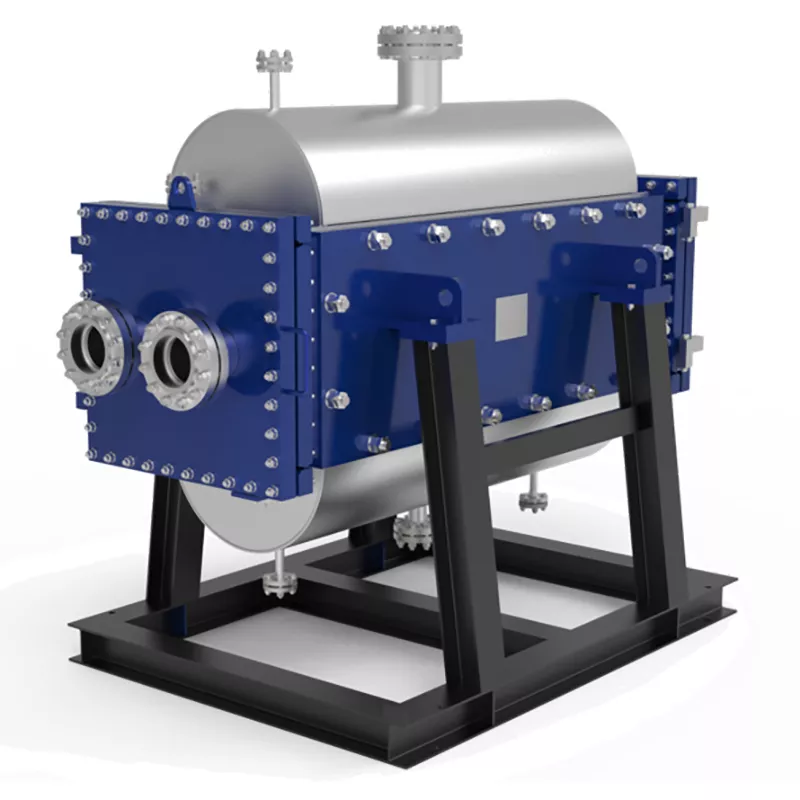
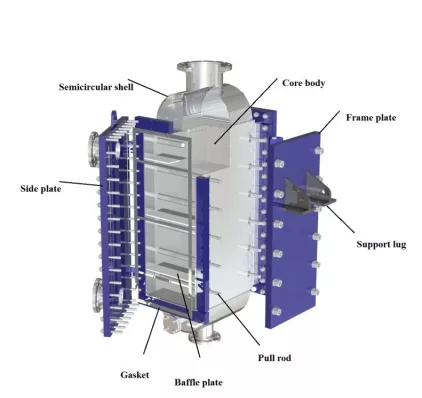
The TP welded plate heat exchanger is a masterclass in bridging two worlds: it encapsulates the superior thermal dynamics of a gasketed plate exchanger into the compact, high-strength profile of a shell-and-tube. An efficient welded plate pack sits inside a robust shell, so the unit delivers high heat transfer while easily withstanding extreme thermal stress and high pressure. Removing gaskets from the wetted pack also removes a fouling and failure point, and the shell provides the mechanical strength for severe service.
How does it conquer fouling, blockage and erosion?
Difficult fluids fail standard exchangers three ways — they foul surfaces, block narrow channels, and erode metal with abrasive particles. SHPHE configures the TP welded unit against all three: custom-tailored channel geometries keep the flow path open and self-scouring so particles pass rather than lodge; wear-resistant metallurgy resists erosion from abrasive slurries; and an integrated cleaning-in-place (CIP) system restores performance without dismantling the unit. Together these deliver production continuity where conventional heat exchangers would clog and stop the line.
Where is the TP welded exchanger used?
| Sector | Difficult media |
|---|---|
| Food & beverage | High-viscosity syrups, purées, fibre-rich juices |
| Pulp & paper | Fibre-laden liquors and process streams |
| Chemical | Particle-laden and viscous process fluids |
| Metallurgy / mining | Slurries and abrasive suspensions |
TP welded vs gasketed vs wide-gap: which for difficult fluids?
| Fluid | Best platform |
|---|---|
| Clean-to-moderate | Gasketed plate |
| Particle-laden slurry / viscous / erosive | TP welded shell-and-plate |
| Fibrous / coarse crystals / high solids | Wide-gap welded |
| High pressure, clean | HT-Bloc welded / PCHE |
The TP welded unit occupies the sweet spot for particle-laden, viscous and erosive fluids that are too difficult for a compact gasketed pack but don't need the fully open channels of a wide-gap unit. When the media is very fibrous or crystallising, SHPHE's wide-gap platform is the better fit — and the same engineering team can advise which to use.
How is it kept running with CIP?
Because difficult fluids foul faster, the TP welded unit integrates cleaning-in-place so operators can circulate a cleaning solution to restore heat transfer without opening the unit or interrupting the wider process. Combined with the self-scouring channel geometry and wear-resistant surfaces, this delivers the long, uninterrupted runs that continuous production lines demand. Monitoring pressure drop and performance — for example with SHPHE's Smart Eye — schedules CIP before fouling degrades output, keeping the line productive.
What makes the channel geometry self-scouring?
The heart of the TP welded unit's anti-fouling ability is its channel geometry, which SHPHE tailors to the specific fluid rather than using a generic plate. For a difficult medium, the channels are shaped and sized so that the flow itself keeps them clean: the velocity and turbulence sweep particles along the flow path instead of letting them settle in dead zones, and the gaps are matched to the largest particle or fibre so nothing lodges and grows into a blockage. This self-scouring action is why the unit can run for long periods on slurries and viscous fluids that would clog a compact gasketed pack within hours. It is engineering the flow path to suit the fluid, not forcing the fluid through a fixed geometry — the same custom philosophy SHPHE applies across its welded platforms, and the reason the TP unit maintains throughput where standard exchangers stall.
How does it protect against erosion and thermal stress?
Abrasive slurries erode metal, and rapidly changing process temperatures impose thermal stress that cracks rigid components — two failure modes that shorten the life of a poorly chosen exchanger on difficult media. The TP welded unit addresses both. Wear-resistant metallurgy on the wetted surfaces resists the scouring of abrasive particles, extending service life in mining and metallurgy duties, while the welded shell-and-plate construction is engineered to absorb extreme thermal stress and high pressure without the gasket or joint failures that plague less robust designs. The result is an exchanger that not only keeps flowing but keeps its integrity over years of severe service — turning what would be a recurring maintenance headache into a dependable, long-life asset. For a continuous production line where an exchanger failure means a costly shutdown, that durability is often worth as much as the thermal performance itself.
Absolute production continuity on difficult media
SHPHE engineers the TP welded plate heat exchanger to directly conquer a plant's severe fouling, blockage and erosion threats. By combining custom channel geometries, wear-resistant metallurgy and integrated CIP, it delivers absolute production continuity where conventional heat exchangers fail — handling particle-laden slurries, high-viscosity syrups and fibre-rich pulp. As a shell-and-plate hybrid, it pairs the thermal efficiency of a plate exchanger with the structural strength of a shell-and-tube, withstanding extreme thermal stress and high pressure in a compact profile. Certified to ASME, NB, CE, BV and SGS with 30+ patents since 2005, each unit is target-engineered to the specific fluid.
Source: SHPHE product information. See the TP welded plate heat exchanger page.
How is the unit specified for a difficult fluid?
Specifying a TP welded unit starts with a detailed picture of the fluid, not just the thermal duty. The engineer needs the particle size and concentration, the viscosity, the abrasiveness, any fibre or crystal content, and how the fluid behaves as it heats or cools — does it thicken, foul or precipitate? From this, the channel geometry is sized so the largest particles pass freely, the metallurgy is chosen to resist the specific erosion, and the CIP regime is matched to the fouling chemistry. Sharing a representative fluid analysis up front is the single most valuable thing a customer can do, because it lets the unit be engineered to keep flowing on that exact medium rather than being a generic compromise. This fluid-first approach is what turns a notoriously troublesome heat-transfer duty into a reliable, continuous operation that runs for long intervals between planned cleanings rather than lurching from one emergency shutdown to the next.
What are the total-cost benefits on difficult fluids?
On difficult media, the economics of the right exchanger are dominated not by purchase price but by uptime. A cheap exchanger that clogs, erodes or fails on a slurry stops the production line, and each unplanned shutdown costs far more than the exchanger itself. The TP welded unit is engineered precisely to avoid those stoppages — its self-scouring geometry, wear-resistant surfaces and integrated CIP keep the line running and lengthen the intervals between interventions. Over a year of continuous operation, the avoided downtime, reduced cleaning labour and extended equipment life typically dwarf any premium over a standard exchanger that was never suited to the fluid in the first place. This is why plants handling slurries, syrups and pulp increasingly specify a purpose-built shell-and-plate unit rather than repeatedly nursing an unsuitable one through failures. The lesson is to match the exchanger to the fluid from the outset, and to value continuity as the primary economic outcome on any difficult-media duty.
Because SHPHE also builds gasketed, wide-gap, HT-Bloc and PCHE platforms, it can recommend the TP welded unit only where it genuinely fits — and move you to a wide-gap or other design where the fluid demands it — so you get the right tool for the job from a single accountable engineering partner rather than a one-size-fits-all product.
As a specialist plate-heat-exchanger manufacturer, SHPHE (Shanghai Heat Transfer Equipment Co., Ltd.) custom-engineers TP welded shell-and-plate units for the toughest fluids, backed by ASME/NB/CE/BV/SGS certification and 30+ patents.
In practice, the plants that succeed with difficult media are those that treat the heat exchanger as a fluid-handling problem first and a thermal problem second. Getting the geometry, metallurgy and cleaning right for the specific slurry, syrup or pulp is what delivers the long, uninterrupted production runs that make the whole line profitable, and it is exactly the engineering SHPHE brings to every TP welded project.
Send SHPHE your fluid details for a target-engineered TP welded design.
Consult our engineers →The TP welded shell-and-plate therefore occupies a valuable middle ground: the robustness and pressure capability associated with shell-and-tube, combined with the efficiency and compactness of plate technology. For demanding high-pressure or high-temperature duties that still benefit from plate-level heat transfer, it is a compelling choice, and SHPHE designs each unit to the exact service conditions.
Frequently asked questions
What is a TP welded shell-and-plate heat exchanger?
A hybrid that places an efficient welded plate pack inside a rugged shell, combining plate-exchanger thermal performance with shell-and-tube strength for severe, fouling or high-pressure duties.
Why choose a shell-and-plate exchanger for slurries?
Its custom channel geometry, wear-resistant metallurgy and integrated CIP resist fouling, blockage and erosion from particle-laden, viscous or fibre-rich fluids, keeping production continuous.
TP welded vs wide-gap — which for difficult fluids?
TP welded suits particle-laden, viscous and erosive fluids; wide-gap suits very fibrous, high-solids or crystallising fluids that need fully unobstructed channels.
Can the TP welded unit be cleaned in place?
Yes — it integrates cleaning-in-place so a cleaning solution restores heat transfer without opening the unit or stopping the process.
What industries use TP welded exchangers?
Food and beverage, pulp and paper, chemical, and metallurgy/mining — anywhere the media is difficult to handle with a standard exchanger.
Sources & further reading: SHPHE product information; general shell-and-plate practice. Suitability depends on the specific fluid — confirm with a thermal design.