Brazed vs Gasketed Plate Heat Exchanger: Performance, Maintenance, and Application Differences
When selecting a plate heat exchanger for your process system, the choice often narrows down to brazed vs gasketed plate heat exchanger designs. Each type serves distinct operational needs, from high-pressure condensation to routine HVAC duties. This article breaks down their performance characteristics, maintenance demands, and ideal applications, helping process engineers and procurement managers make informed decisions. We cover working principles, typical parameter ranges, and real-world scenarios, with a focus on how SHPHE’s product lines—including HT-Bloc welded units and gasketed plate heat exchangers—fit into your system.
What Is a Brazed Plate Heat Exchanger?
A brazed plate heat exchanger consists of a stack of corrugated stainless steel plates joined together by copper or nickel brazing in a vacuum furnace. This creates a single, compact block with no gaskets or frame parts. The brazed construction eliminates potential leak paths, making it suitable for high-pressure and high-temperature applications. Typical design pressures range up to 30 bar, and temperatures can reach 220°C, depending on the brazing material. These units are commonly used in refrigeration, heat pumps, and oil cooling systems where space is tight and maintenance access is limited.
What Is a Gasketed Plate Heat Exchanger?
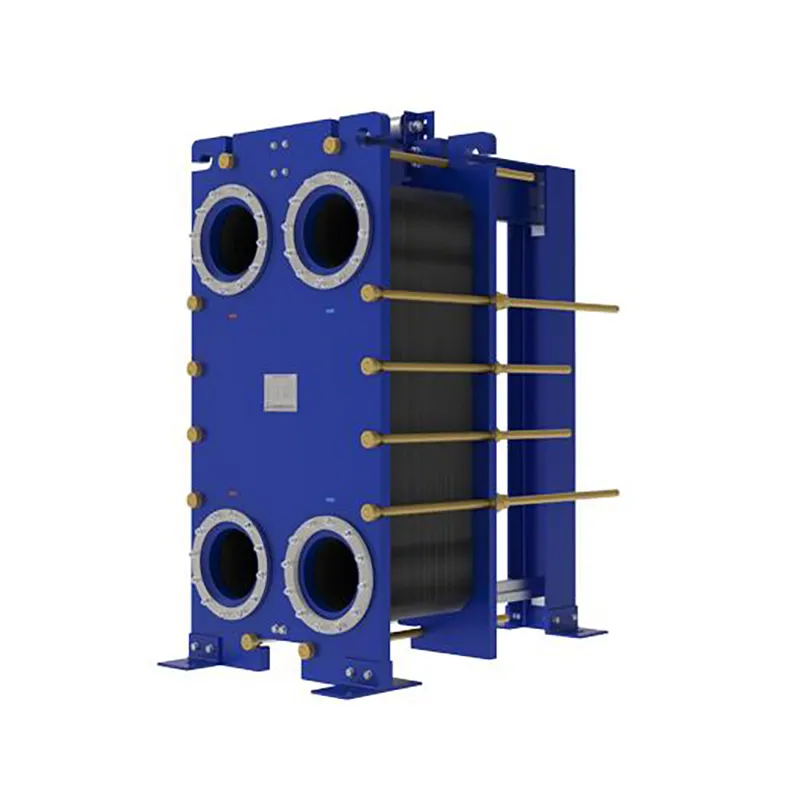
A gasketed plate heat exchanger uses elastomeric gaskets between each plate to seal the fluid channels. The plate pack is clamped between a fixed and a movable frame, allowing easy disassembly for cleaning, inspection, or plate replacement. This design is highly flexible—you can add or remove plates to adjust thermal capacity. Standard operating limits are around 25 bar and 180°C, though specialized gasket materials can extend these ranges. Gasketed units dominate in HVAC, food processing, chemical, and marine applications because of their serviceability and adaptability.
How Do Their Working Principles Differ?
Both types rely on countercurrent flow through corrugated plates to achieve high heat transfer coefficients. However, the brazed design creates a permanent bond between plates, eliminating any bypass or leakage between channels. In a gasketed unit, the gaskets direct the flow and prevent mixing, but they also introduce a potential failure point. The brazed unit is essentially a sealed cartridge, while the gasketed unit is a serviceable assembly. For processes that require absolute fluid separation—such as ammonia refrigeration—the brazed type is often preferred. For applications where fouling is expected, the gasketed design allows mechanical cleaning.
Performance Comparison: Key Parameters
The table below summarizes typical performance ranges for brazed vs gasketed plate heat exchangers. These values represent industry-standard capabilities, not specific to any single manufacturer.
| Parameter |
Brazed PHE |
Gasketed PHE |
| Max operating pressure |
30 bar (435 psi) |
25 bar (362 psi) |
| Max operating temperature |
220°C (428°F) |
180°C (356°F) |
| Heat transfer coefficient |
3,000–7,000 W/m²K |
2,500–6,000 W/m²K |
| Plate material |
SS304 / SS316 |
SS304 / SS316 / Titanium |
| Leak detection |
Not possible (sealed) |
Visible at gaskets |
| Capacity modification |
Replace unit |
Add/remove plates |
Maintenance: Which One Is Easier to Service?
Maintenance is where the two designs diverge most. A gasketed plate heat exchanger can be fully disassembled in a few hours. You can inspect each plate for scaling or pitting, replace damaged plates, and change gaskets. This makes it ideal for processes with dirty fluids or frequent product changeovers. In contrast, a brazed unit is non-serviceable. If fouling occurs internally, chemical cleaning is the only option. If a brazed plate leaks, the entire exchanger must be replaced. For this reason, many plants use brazed units in clean, closed-loop systems and gasketed units in open or fouling-prone circuits.
Application Scenarios: Where Does Each Excel?
Choosing between brazed vs gasketed plate heat exchanger designs depends on your process conditions:
- Brazed PHE: Refrigeration condensers and evaporators, heat pump water heaters, oil coolers in hydraulic systems, and high-temperature industrial processes where compactness and leak-tightness are critical.
- Gasketed PHE: HVAC district heating and cooling, dairy and beverage pasteurization, chemical processing with frequent cleaning cycles, and marine engine cooling systems.
For applications that fall in between—such as aggressive chemicals or very high pressures—SHPHE offers HT-Bloc welded plate heat exchangers and wide gap welded plate heat exchangers, which combine the serviceability of gasketed units with the leak resistance of welded construction.
Why Choose SHPHE for Your Heat Exchanger Needs?
SHPHE is a Shanghai-based manufacturer founded in 2005, exporting to over 20 countries with ISO9001 and ASME U certifications. Our product range includes TP welded plate heat exchangers, gasketed plate heat exchangers, PCHE, plate air preheaters, and pillow plates. We provide free thermal design and selection services, helping you match the right technology—whether brazed, gasketed, or welded—to your specific flow rate, temperature, pressure, and media requirements. Our engineers can also recommend alternatives compatible with Alfa Laval or GEA designs when retrofitting existing installations.
Frequently Asked Questions
1. Can a brazed plate heat exchanger be cleaned after fouling?
Yes, but only through chemical cleaning. You cannot open a brazed unit for mechanical cleaning. For heavy fouling, a gasketed or welded design is more practical.
2. Is a gasketed plate heat exchanger suitable for high-pressure steam?
Standard gasketed units handle up to 25 bar. For higher pressures, consider a brazed or welded plate heat exchanger. SHPHE’s HT-Bloc series can operate at higher design pressures.
3. How often should gaskets be replaced in a gasketed PHE?
Gasket life depends on temperature and fluid compatibility. Typically, replacement is needed every 3 to 5 years. Regular inspection during maintenance intervals is recommended.
4. Which type offers better thermal efficiency—brazed or gasketed?
Brazed units generally have slightly higher heat transfer coefficients because there are no gaskets interrupting the plate surface. However, the difference is often marginal in real-world systems.
5. Can I use a brazed PHE as a direct replacement for a gasketed unit?
Only if your process is clean and you do not need access for cleaning. For fouling fluids or frequent maintenance, a gasketed or welded design is more appropriate.
6. Does SHPHE provide custom designs for brazed or gasketed exchangers?
Yes. SHPHE offers free thermal design and selection. Provide your flow rate, temperature, pressure, and media details, and our engineers will recommend the optimal configuration.
Request a Quote for Your Plate Heat Exchanger
To get a precise recommendation for your brazed vs gasketed plate heat exchanger decision, please send us your process parameters: flow rate, inlet and outlet temperatures, operating pressure, and fluid media. SHPHE’s engineering team will perform a free thermal selection and provide a quotation tailored to your system. Contact us today with your project details.

 English EN





User Comments
Service Experience Sharing from Real Customers
mike_harper
Maintenance SupervisorSwitched from gasketed to brazed units in our chiller loop last quarter. The footprint is half the size and I haven't touched a single gasket since installation. No leaks, no hassle. For closed-loop systems, brazed is the clear winner.
sarah_connor
Process EngineerWe still run gasketed for our dairy CIP because we need to open them up for cleaning every shift. But for the glycol side, we went brazed. Performance is solid, though once they foul, you can't mechanically clean them. Trade-offs are real.
tom_beckett
Facility ManagerI was skeptical about brazed units for our HVAC retrofit because of the cost, but the energy savings paid off in 14 months. Gasketed units we had before were constantly weeping at the seals. These things are tanks. Just make sure your water treatment is dialed in.
lisa_chan
Plant OperatorFor our specific application — high temp, high pressure steam condensate — gasketed is the only way to go because we need to swap plates every six months. Brazed would be a nightmare to replace. But if you don't need that flexibility, brazed is way more compact and leak-proof.