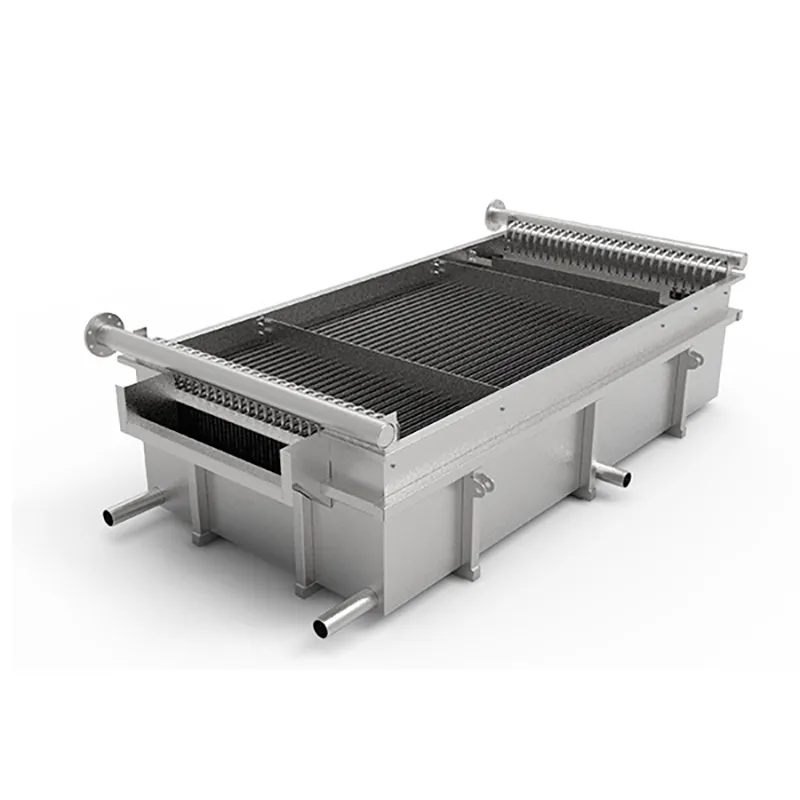
Plate and Shell Condenser: Why It Beats Shell & Tube
When it comes to condensation duties in industrial processes, engineers have long relied on shell and tube heat exchangers. But a newer configuration—the plate and shell condenser—is quietly changing the game. Combining the compactness of plate heat exchangers with the ruggedness of shell-and-tube designs, this technology offers measurable advantages in heat transfer efficiency, footprint, and maintenance. This article breaks down exactly why plate and shell condensers outperform traditional shell and tube units in real-world applications, backed by performance data and operational insights.
Heat Transfer Efficiency: The Core Advantage
The fundamental difference lies in the heat transfer surface geometry. A plate and shell condenser uses corrugated plates that create highly turbulent flow paths, even at low velocities. This turbulence breaks the thermal boundary layer much more effectively than the laminar flow typically found in shell and tube units. In practical terms, the overall heat transfer coefficient (U-value) for a plate and shell condenser ranges between 3,000 to 7,000 W/m²·K for water-to-water duties, whereas a comparable shell and tube unit typically achieves only 1,000 to 2,500 W/m²·K. For condensing steam against cooling water, the plate and shell design can deliver U-values of 4,500 W/m²·K or higher, depending on the plate pattern and operating pressure.
What does that mean for your process? Simply put, you need significantly less surface area to achieve the same condensation duty. A plate and shell condenser can be 60% to 80% smaller than a shell and tube unit for the same thermal load. That translates directly into reduced floor space, lower material costs, and less refrigerant or cooling water inventory in the system.
Compact Footprint and Weight Savings
Space is always at a premium in industrial plants, whether it is a retrofit project or a new build. The plate and shell condenser's design eliminates the need for a large cylindrical shell, large-diameter tubesheets, and heavy baffles. Instead, the plates themselves form the heat transfer matrix, and the pressure-containing shell is a relatively thin cylinder that wraps around the plate stack. This construction reduces the weight of the exchanger by 50% or more compared to an equivalent-duty shell and tube unit.
For offshore platforms, skid-mounted systems, or plants where structural steel is a cost factor, this weight reduction is a game-changer. Installation becomes simpler, requiring lighter cranes and less robust foundations. Additionally, the smaller volume of the plate and shell unit means less hold-up volume for the process fluid, which is particularly beneficial when handling expensive refrigerants or hazardous chemicals.
Temperature Approach and True Countercurrent Flow
One of the most overlooked advantages of the plate and shell condenser is its ability to achieve a true countercurrent flow arrangement. In a shell and tube unit, the shell-side flow is typically a cross-flow or a combination of cross-flow and counter-flow, depending on the baffle design. This limits the minimum temperature approach to about 5°C to 10°C. The plate and shell design, however, allows for pure countercurrent flow between the condensing vapor and the cooling medium, enabling temperature approaches as low as 1°C to 2°C.
This capability is critical in applications like subcooling condensate or recovering low-grade heat. If your process requires a close temperature approach to maximize energy recovery or to meet specific outlet conditions, the plate and shell condenser gives you a distinct thermodynamic advantage. You can also use higher cooling water temperatures while still achieving the required condensation rate, which can reduce the load on cooling towers or chillers.
Pressure Drop and Operating Flexibility
Engineers often worry that the narrow channels in a plate heat exchanger will lead to excessive pressure drops. While it is true that the plate side pressure drop is higher than a single tube pass, the overall system pressure drop is often comparable or even lower. Here is why: because the heat transfer coefficient is so much higher, the required flow velocity for a given duty is lower. You can operate at lower flow rates and still maintain turbulent conditions, which reduces the pressure drop per unit of heat transferred.
Moreover, the plate and shell condenser offers excellent flexibility in handling multiple passes. By using different plate configurations, you can arrange the process stream in multiple passes to match the available pressure drop. For condensing duties where the vapor volume changes dramatically along the flow path, the plate pattern can be tailored to accommodate the varying specific volume, ensuring stable operation across a wide turndown range. This is particularly valuable in refrigeration systems that experience seasonal load variations.
Maintenance and Cleaning Considerations
Shell and tube condensers are notorious for fouling on the shell side, especially when the cooling water contains suspended solids or biological growth. Cleaning the shell side requires pulling the tube bundle, which is a time-consuming and labor-intensive operation. The plate and shell condenser addresses this issue in two ways. First, the high turbulence on both sides of the plate minimizes fouling deposition. Second, the design allows for mechanical cleaning of the plate surfaces without removing the unit from the piping.
Depending on the specific model, you can either open the unit for access to the plate pack or use clean-in-place (CIP) procedures with appropriate cleaning solutions. The smooth plate surfaces have no crevices or dead zones where deposits can accumulate, unlike the crevices between tubes and baffles in a shell and tube exchanger. For processes that are prone to fouling, such as those using untreated river water or process streams with polymerization tendencies, the plate and shell design can significantly extend the time between maintenance shutdowns.
Handling High Pressure and Temperature
One common misconception is that plate heat exchangers are not suitable for high-pressure applications. While traditional gasketed plate heat exchangers are limited to about 25 bar, the welded plate and shell design changes that narrative. By using laser-welded plate pairs and a cylindrical pressure shell, these units can handle design pressures up to 100 bar or more, depending on the shell thickness and material of construction. The absence of gaskets also eliminates the risk of gasket blowout at elevated temperatures.
For condensing duties in high-pressure refrigerant systems, ammonia plants, or steam systems operating above 40 bar, the plate and shell condenser provides a robust solution that does not sacrifice thermal performance. The welded construction also makes it suitable for handling aggressive fluids that would attack elastomeric gaskets, such as certain amines, acids, or hydrocarbon streams with aromatic content.
Real-World Performance Data
Consider a typical refrigeration application where ammonia is condensed at 35°C using cooling water available at 28°C. A shell and tube condenser with a 1-inch tube diameter and 25% baffle cut would require approximately 120 m² of surface area to handle a 500 kW heat load. The overall heat transfer coefficient would be around 1,800 W/m²·K, and the unit would weigh roughly 3,500 kg.
In contrast, a plate and shell condenser for the same duty would require only about 35 m² of plate surface area, with an overall heat transfer coefficient of 5,200 W/m²·K. The weight would be approximately 1,200 kg, and the footprint would be reduced by 70%. The pressure drop on the cooling water side would be slightly higher, but the pumping energy penalty is more than offset by the savings in fan or pump power at the cooling tower, since the lower approach temperature allows the cooling water to return at a higher temperature.
Applications Where Plate and Shell Excels
The plate and shell condenser is not a universal replacement for all shell and tube units, but it excels in specific scenarios:
Refrigeration and heat pump systems – The compact design and low refrigerant charge make it ideal for both industrial and commercial refrigeration. The ability to achieve a close approach temperature improves the coefficient of performance (COP) of the system.
Chemical and petrochemical processing – When condensing mixed hydrocarbon vapors or corrosive process streams, the welded plate construction offers superior material compatibility. Units can be fabricated from titanium, Hastelloy, or duplex stainless steel without the cost penalty associated with large-diameter shell and tube bundles.
Power generation – Low-pressure steam condensation in geothermal plants or waste heat recovery units benefits from the high heat transfer rates and compact footprint, especially in retrofit projects where space is constrained.
Marine and offshore – The weight and space savings are critical on vessels and platforms. The plate and shell condenser's resistance to vibration and its ability to handle motion-induced forces make it a reliable choice for shipboard refrigeration and process systems.
Cost Comparison Over the Full Lifecycle
Looking at the initial purchase price, a plate and shell condenser may have a higher cost per square meter of surface area compared to a shell and tube unit. However, when you consider the total installed cost, the picture changes dramatically. The smaller footprint reduces piping runs, structural steel, and foundation costs. The lower weight reduces rigging and installation labor. The reduced hold-up volume means less refrigerant or process fluid inventory, which can be a significant cost saving for expensive refrigerants like R-134a or ammonia.
Over the operating life, the higher thermal efficiency means lower energy consumption for the same duty. Reduced fouling means less frequent cleaning, lower chemical treatment costs, and less downtime. When you factor in all these elements, the plate and shell condenser typically delivers a lower total cost of ownership within the first two to three years of operation.
Design Considerations and Selection Criteria
When evaluating whether a plate and shell condenser is right for your application, consider the following factors:
First, the cleanliness of the cooling medium. If you are using seawater or untreated river water, you need to verify that the plate gap is sufficient to prevent blockage from debris. Most manufacturers offer wide-gap plate designs for such applications, but this reduces the heat transfer coefficient somewhat. Second, the operating pressure and temperature must be within the unit's design envelope. While modern plate and shell units handle high pressures well, you should always consult the manufacturer's rating for your specific duty.
Third, consider the thermal cycling frequency. If your process undergoes frequent start-stop cycles or rapid temperature swings, the welded plate construction handles thermal fatigue better than gasketed designs, but you should still discuss the duty cycle with the manufacturer to ensure the plate material and thickness are appropriate. Finally, think about future capacity expansion. The plate and shell design allows for adding plates to increase capacity, provided the shell is designed with that in mind. This modularity is a distinct advantage over shell and tube, where capacity changes typically require a completely new unit.
The Verdict: A Superior Choice for Modern Condensation Duties
The plate and shell condenser is not just a niche alternative; it is a superior technology for a wide range of condensation applications. Its advantages in heat transfer efficiency, compactness, weight, temperature approach, and maintenance accessibility make it a compelling choice for engineers who are willing to look beyond traditional designs. While shell and tube condensers will continue to have a place in certain high-fouling or extremely high-pressure services, the plate and shell design offers a more efficient and cost-effective solution for most modern industrial processes.
If you are evaluating condenser options for a new project or considering a retrofit to improve efficiency, it is worth requesting a thermal design comparison from a manufacturer that offers both technologies. The performance data will likely surprise you, and the savings in space, weight, and energy will make a compelling business case. For more detailed information on related plate heat exchanger technologies, you can explore gasketed plate heat exchanger designs or learn about welded plate heat exchanger options for other process applications. The right choice depends on your specific operating conditions, but the evidence clearly points toward plate and shell technology as the future of efficient condensation.

 English EN