
A plate heat exchanger transfers heat between two fluids through a series of thin, corrugated metal plates. The design creates a large surface area within a compact footprint, enabling rapid thermal exchange. For demanding industrial environments, welded plate heat exchangers offer a robust alternative to traditional gasketed units, handling higher pressures, temperatures, and challenging fluids without compromising efficiency.
In a plate heat exchanger, hot and cold fluids flow through alternating channels formed by the plates. The plates are corrugated to promote turbulence, which significantly improves heat transfer rates. Each plate has gaskets or welded seams that direct the fluids into their respective passages, preventing any mixing. The hot fluid transfers its thermal energy through the plate material to the cold fluid on the adjacent side, achieving efficient temperature exchange in a fraction of the space required by shell-and-tube designs.
The TP Welded Plate Heat Exchanger takes this concept further by welding the plate pack together, eliminating gaskets that can fail under extreme conditions. This hybrid design combines the thermal efficiency of plate technology with the structural integrity of a pressure vessel, making it suitable for applications involving high temperatures up to 900°C and pressures up to 60 bar.
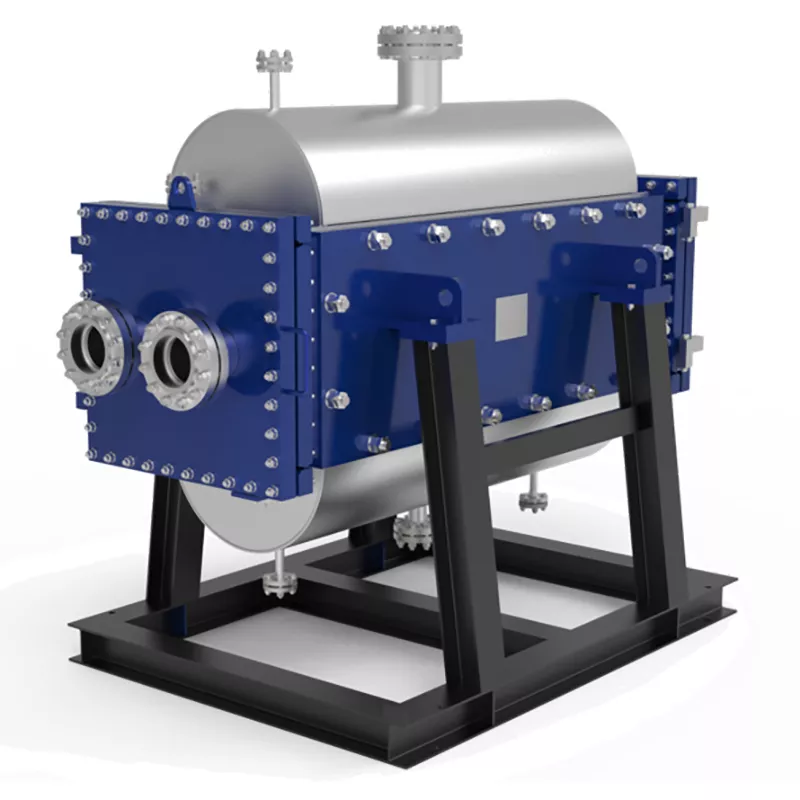
The primary advantage of a welded plate heat exchanger lies in its ability to handle challenging media. Particle-laden slurries, high-viscosity syrups, and fiber-rich pulp can quickly clog conventional units, but the TP design offers wider channel gaps and customizable plate spacing to accommodate these demanding fluids. For operations in oil and gas, chemical processing, and offshore installations, this translates to fewer shutdowns and lower maintenance costs.
Another significant benefit is the four-side openable bolted construction available on certain models. This feature allows operators to access all sides of the plate pack for thorough cleaning and inspection without dismantling the entire unit. Combined with integrated Clean-in-Place systems, maintenance downtime is minimized, and production continuity is maintained—a critical factor in continuous processing industries.
The Plate & Frame Heat Exchanger remains an excellent choice for lower-pressure duties where gasket replacement is acceptable. However, when your process involves aggressive chemicals or severe thermal cycling, the TP Plate Heat Exchanger provides the durability and peace of mind that gasketed units cannot match.
One of the most critical aspects of plate heat exchanger performance is material compatibility. Standard stainless steel grades work well for many applications, but erosive slurries or chloride-rich seawater require more specialized metallurgy. Manufacturers can supply plates made from pure titanium, Hastelloy, or other exotic alloys to resist corrosion at the molecular level. Plate thickness typically ranges from 0.6 to 1.5 mm, balancing thermal conductivity with mechanical strength.
Custom flow simulation plays an equally important role. Engineers model the fluid behavior using specialized software to optimize plate spacing, corrugation patterns, and flow arrangements. Multi-pass counter-flow configurations achieve close temperature approaches, while cross-flow arrangements suit applications with strict pressure drop limitations. This level of customization ensures the heat exchanger integrates seamlessly into your existing process line, reducing installation time and long-term operational costs.
Robotic welding and non-destructive testing guarantee defect-free seams, even under intense fatigue cycling. Certifications such as ASME, CE, and NB provide additional assurance that the equipment meets rigorous international standards. Whether you are upgrading an existing facility or designing a new processing plant, understanding how these systems work and what they offer helps you make an informed decision that balances performance, reliability, and total cost of ownership.



 English EN