
 English EN


TL;DR — The quick answer
What it is: a printed circuit heat exchanger (PCHE) — chemically-etched micro-channels diffusion-bonded into a solid metal block.
Why it's used: extreme pressure (100+ bar) and temperature capability in an ultra-compact, gasket-free core.
Key duty: supercritical CO₂ (sCO₂) power cycles and energy storage, plus hydrogen and LNG.
Advantages: very high pressure rating, compactness, safety and a close temperature approach.
Best for: next-generation power, energy storage and high-pressure process duties.
As power and energy-storage systems move to high-pressure working fluids like supercritical CO₂ (sCO₂), they need a heat exchanger that combines extreme pressure capability with compactness and efficiency. The printed circuit heat exchanger (PCHE) is that device. This guide explains how the PCHE works, why it suits sCO₂ and energy storage, and where its unique construction gives it an edge.
The PCHE is the most extreme member of the plate-heat-exchanger family: instead of stamped plates, it uses chemically-etched micro-channels bonded into a solid block, giving it a pressure and temperature envelope far beyond conventional exchangers. SHPHE builds PCHEs for the demanding new duties — sCO₂ cycles, energy storage, hydrogen and LNG — where this capability is essential.
What is a printed circuit heat exchanger (PCHE)?
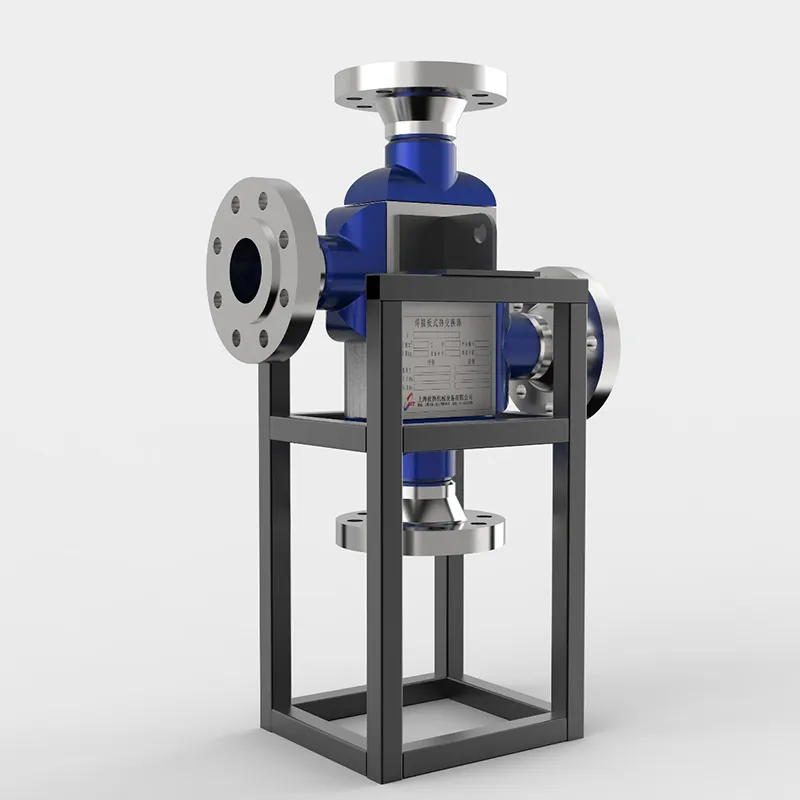
A PCHE is made by chemically etching fine flow channels into flat metal plates — the same photochemical process used to make printed circuit boards, hence the name — and then diffusion-bonding the plates together into a single solid block. Diffusion bonding fuses the plates at the atomic level, so the finished core behaves like one piece of metal with no gaskets, no braze and no weakness at the joints. This gives the PCHE an extraordinary combination: very high pressure capability (often 100+ bar and beyond), high temperature tolerance, and an ultra-compact size — a PCHE can be a fraction of the volume of any other exchanger for the same duty. The micro-channels also give a very high heat-transfer area per unit volume, so it is both compact and efficient.
Why is PCHE ideal for supercritical CO₂?
Supercritical CO₂ power cycles operate at very high pressure — often well above 100 bar — and rely on efficient heat exchange (recuperation) to achieve their high efficiency. Conventional exchangers struggle at these pressures or become impractically large. The PCHE is purpose-built for the duty: its diffusion-bonded block easily withstands sCO₂ pressures, its micro-channels give the close temperature approach that recuperators need for high cycle efficiency, and its compactness suits the tight, high-power-density layouts of sCO₂ systems. This is why the PCHE has become the enabling heat-exchanger technology for sCO₂ power generation and energy storage — few other devices can meet the pressure and efficiency demands together.
How does PCHE support energy storage?
Emerging long-duration energy-storage systems — including sCO₂-based and thermal-storage cycles — charge and discharge by moving heat at high pressure between working fluids and storage media. The PCHE fits this role naturally: it transfers heat efficiently at the high pressures these cycles use, in a compact, robust core that can cycle reliably. As grid-scale storage scales up to balance renewable power, high-pressure heat exchange becomes a critical component, and the PCHE's combination of pressure capability, efficiency and compactness makes it a key enabler. SHPHE engineers PCHE cores for these next-generation storage and power duties, matching the channel design and materials to the specific working fluid and pressure.
What other duties suit a PCHE?
| Duty | Why PCHE |
|---|---|
| Supercritical CO₂ power & storage | Extreme pressure + close approach |
| Hydrogen (production & refuelling) | High-pressure H₂ cooling & heat exchange |
| LNG processing | Compact cryogenic heat exchange at pressure |
| Hydrocarbon / refining | High-pressure process heat recovery |
PCHE vs conventional exchangers
| Attribute | PCHE | Gasketed / welded plate | Shell-and-tube |
|---|---|---|---|
| Pressure rating | Extreme (100+ bar) | Moderate–high | High |
| Compactness | Highest | High | Low |
| Temperature approach | Very close | Close | Wider |
| Cleaning | Chemical only | Open / CIP | Mechanical |
The PCHE occupies the extreme end of the spectrum: unmatched pressure capability and compactness, best suited to clean, high-pressure fluids (its micro-channels are not for fouling or solids-laden media). For those duties, no other exchanger matches it — which is why it is the technology of choice for sCO₂, hydrogen and cryogenic high-pressure applications.
Why is diffusion bonding so important?
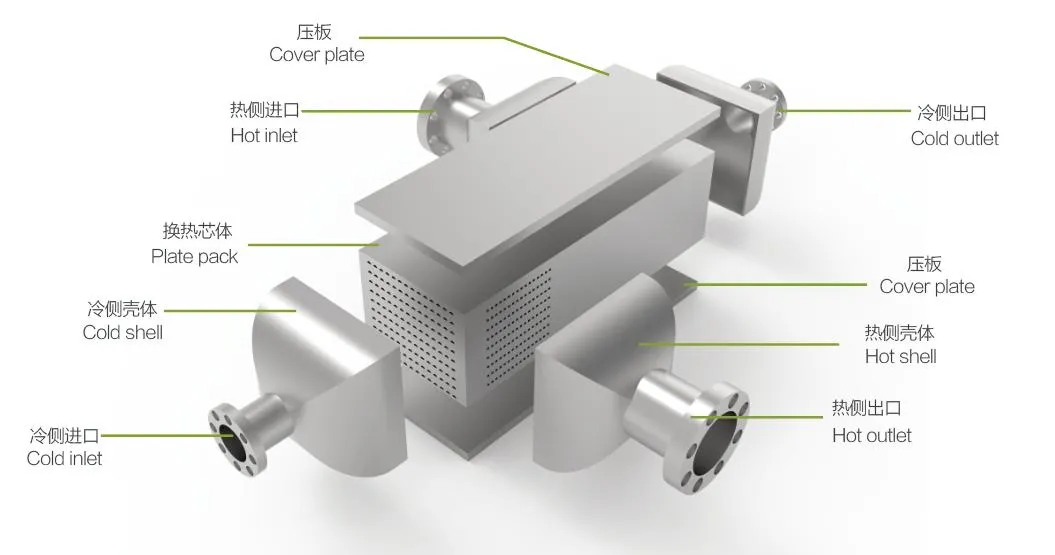
The diffusion-bonding step is what gives the PCHE its extraordinary strength, and it is worth understanding why. In diffusion bonding, the stacked, etched plates are pressed together at high temperature and pressure so the metal grains grow across the interfaces, fusing the plates into a monolithic block. The finished core has essentially the same strength as the parent metal, with no gaskets, no brazing filler and no welds at the channel walls to act as weak points. This is why a PCHE can hold pressures of 100 bar and far beyond that would burst a conventional exchanger — there is simply no joint to fail. It also means the core is highly resistant to pressure cycling and thermal fatigue, which matters for power and energy-storage cycles that charge and discharge repeatedly. The trade-off is that the block cannot be opened, so the fluids must be clean; but for the high-pressure, clean duties the PCHE targets, diffusion bonding delivers a level of integrity no other construction can match.
What are the safety and compactness benefits?
Two further advantages make the PCHE attractive for advanced systems. First, safety: the solid, jointless core contains high-pressure fluids with a large margin, and its small internal volume means less stored energy in the event of any fault — an important consideration for high-pressure hydrogen and sCO2 systems where safety is paramount. Second, compactness: because the micro-channels pack an enormous heat-transfer area into a tiny volume, a PCHE can be a small fraction of the size and weight of any other exchanger for the same high-pressure duty. This is decisive in space- and weight-constrained applications — offshore, modular power units, and compact energy-storage skids — where a bulky exchanger simply would not fit. Together, extreme pressure capability, safety and compactness make the PCHE uniquely suited to the next generation of high-pressure energy systems, and they are the reasons it has become the enabling heat-exchanger technology for sCO2 power and long-duration storage.
Enabling next-generation high-pressure cycles
SHPHE builds diffusion-bonded PCHE cores for the most demanding high-pressure duties — supercritical CO₂ power and energy storage, green hydrogen, and LNG. By chemically etching micro-channels and diffusion-bonding the plates into a solid block, the PCHE achieves extreme pressure and temperature capability with a close temperature approach in an ultra-compact, gasket-free core. This makes it the enabling heat-exchanger technology for the efficient, high-pressure cycles at the heart of modern power and energy-storage systems. Certified and quality-controlled to international standards with 30+ patents since 2005, SHPHE matches the channel geometry and metallurgy to each working fluid, delivering the reliability these safety-critical, high-pressure applications require.
Source: SHPHE product information. See the printed circuit heat exchanger page.
Why is PCHE central to the energy transition?
The technologies at the heart of the energy transition — supercritical CO2 power cycles, long-duration energy storage, and green hydrogen — all share a demand for efficient heat exchange at high pressure, and the PCHE is one of the few devices that can deliver it. As these systems scale from demonstration to commercial deployment through the second half of the decade, the need for compact, high-pressure, high-integrity heat exchangers grows with them. The PCHE's ability to combine extreme pressure capability, a close temperature approach for high efficiency, safety and compactness positions it as an enabling component of this transition. For engineers designing next-generation power and storage systems, understanding and specifying the PCHE correctly is increasingly part of delivering an efficient, safe and commercially viable plant. In that sense, the PCHE is not just another heat exchanger but a foundational technology on which several of the most promising clean-energy pathways depend for their real-world performance, and its role will only grow as those pathways move toward large-scale commercial deployment.
How is a PCHE specified?
Because the PCHE is a precision, high-pressure device, specification is detailed. The engineer needs the working fluids and their pressures and temperatures (which set the block design and material), the thermal duty and required approach, and confirmation that the fluids are clean — the micro-channels demand fouling-free service. Materials are typically stainless steel or high alloys chosen for the pressure, temperature and fluid; for cryogenic LNG or corrosive service, the metallurgy is matched accordingly. Because the core is diffusion-bonded and cannot be opened, cleanliness and correct material selection are critical from the outset. SHPHE engineers each PCHE to the exact cycle conditions, which is what delivers the safety and efficiency these applications demand.
As a specialist plate-heat-exchanger manufacturer, SHPHE (Shanghai Heat Transfer Equipment Co., Ltd.) engineers diffusion-bonded PCHE cores for supercritical CO₂, hydrogen, LNG and high-pressure duties, backed by international certification and 30+ patents.
Send SHPHE your fluids, pressures and duty for a diffusion-bonded PCHE design.
Consult our engineers →As supercritical-CO₂ power cycles and high-pressure energy storage scale up, the diffusion-bonded PCHE is emerging as an enabling technology, delivering extreme pressure and temperature capability in a remarkably compact, robust form. SHPHE engineers PCHE units to the exacting requirements of these advanced-energy applications for safe, efficient, long-life service.
Frequently asked questions
What is a printed circuit heat exchanger (PCHE)?
An exchanger made by chemically etching micro-channels into plates and diffusion-bonding them into a solid block, giving extreme pressure and temperature capability in an ultra-compact, gasket-free core.
Why is PCHE used for supercritical CO₂?
Because sCO₂ cycles run at very high pressure and need a close temperature approach for efficiency — the PCHE withstands the pressure and provides the approach in a compact core.
How does PCHE support energy storage?
Long-duration storage cycles move heat at high pressure between fluids and storage media; the PCHE transfers that heat efficiently and reliably in a robust, compact block.
What pressure can a PCHE handle?
Very high — often 100 bar and well beyond — because the diffusion-bonded block behaves like a single piece of metal with no gaskets or braze joints to fail.
Can a PCHE handle fouling fluids?
No — its fine micro-channels require clean, fouling-free fluids. Fibrous or solids-laden media need a wide-gap or TP welded exchanger instead.
Sources & further reading: SHPHE product information; general PCHE practice. Pressure/temperature capability depends on the specific core design and material — confirm with an engineered design.