
 English EN


TL;DR — The quick answer
What it solves: clogging and fouling from fibrous, high-solids, crystallising or viscous fluids.
How: wide, unobstructed laser-welded channels with no dead zones, sized to the fluid's grain and fibre.
Applications: pulp & paper liquors, sugar juices, wastewater/sludge, and other high-TSS streams.
Formats: compact vertical or versatile horizontal, cutting footprint while keeping flow open.
Result: continuous operation, low pressure drop and no media stagnation where standard PHEs clog.
Many industrial fluids carry fibres, crystals or suspended solids that would clog a standard plate heat exchanger within hours. For these, SHPHE's wide gap plate heat exchanger provides wide, unobstructed channels that let the difficult media pass while still transferring heat efficiently. This guide focuses on the applications — pulp, sugar, wastewater and other high-total-suspended-solids (high-TSS) streams — and how the wide-gap design keeps them flowing.
The core problem with fibrous and high-solids fluids is stagnation: in a narrow, corrugated channel, fibres bridge and crystals lodge, building into blockages that stop the line. The wide-gap unit is engineered specifically to eliminate that failure mode, and understanding which fluids it suits — and why — is the key to specifying it correctly.
Why do fibrous and high-TSS fluids clog standard PHEs?
A conventional gasketed or compact welded plate exchanger uses narrow channels with tight corrugations to create turbulence and high heat transfer. That works beautifully for clean fluids — but for a fluid carrying fibres, coarse crystals or solid suspensions, those narrow channels and corrugation contact points become traps. Fibres catch and bridge across the gap, crystals settle in low-velocity zones, and solids accumulate until the channel blocks. The result is rising pressure drop, falling heat transfer and, eventually, a shutdown to clean or clear the unit. No amount of cleaning fixes a fundamentally unsuitable geometry — the answer is a channel wide enough for the media to pass.
How does the wide-gap design keep fluids flowing?
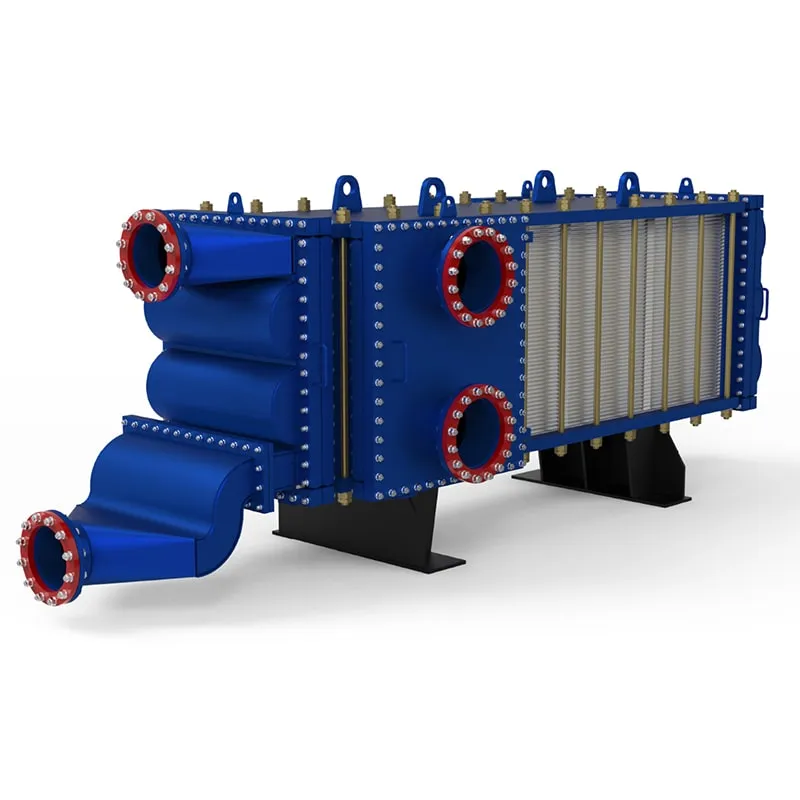
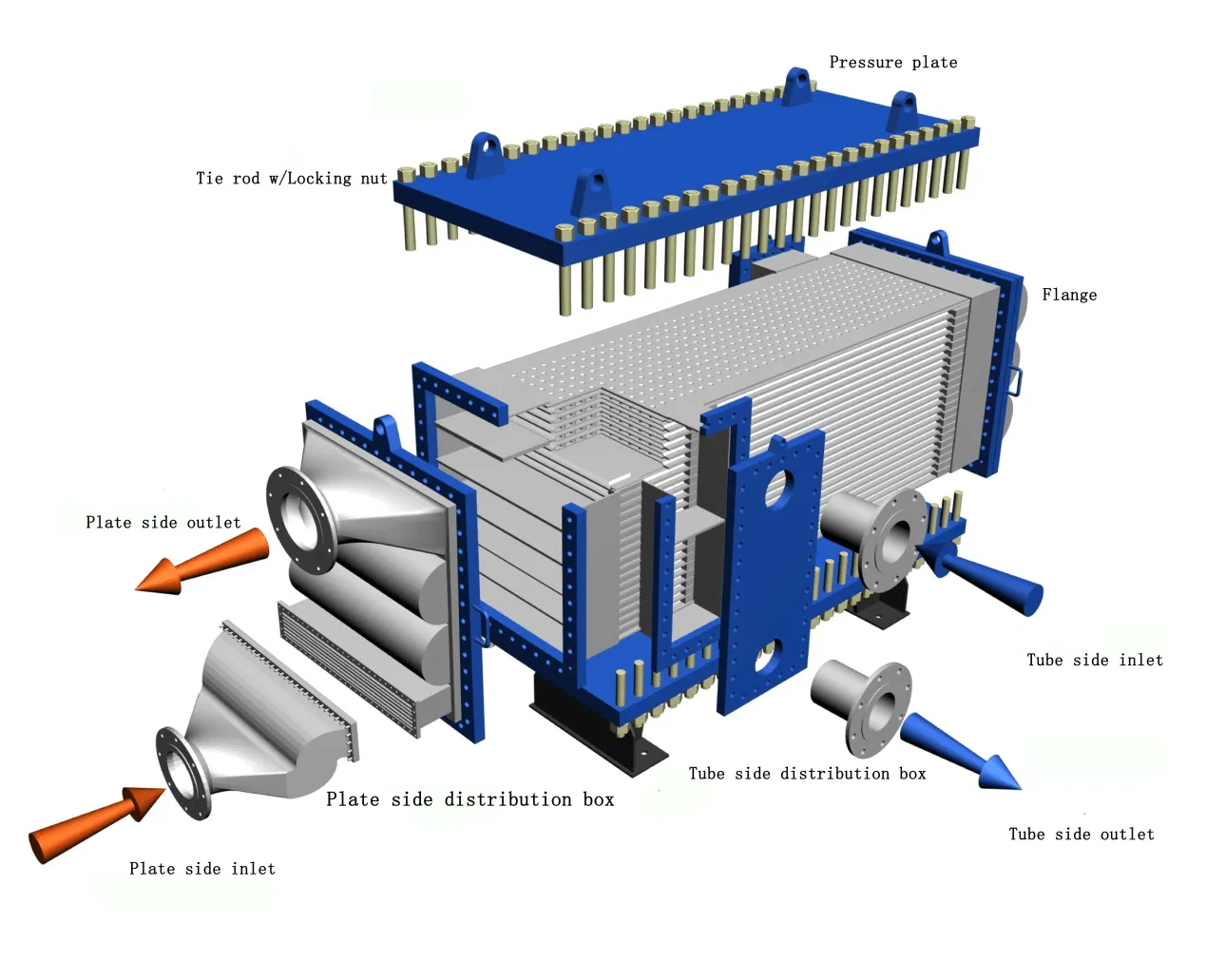
The SHPHE wide gap welded plate heat exchanger uses a gasket-free fully welded architecture with wide, non-obstructed channels formed by laser-welded plate packs. Crucially, each channel is calculated and formed to match the fluid's exact rheology and grain size, so the gap is wide enough for the largest fibre or crystal to pass without bridging. This completely eliminates the structural "dead zones" where media would otherwise stagnate. The flow stays open and largely self-scouring, so the unit maintains throughput and low pressure drop on fluids that would clog a standard pack. It is a purpose-built geometry, not a compromise — engineered around the difficult fluid rather than forcing the fluid through a fixed narrow channel.
Which applications suit the wide-gap exchanger?
| Industry | Difficult fluid |
|---|---|
| Pulp & paper | Fibre-laden black/white liquors, process streams |
| Sugar | Juice, syrup and crystallising streams |
| Wastewater / environmental | Sludge, high-TSS effluent, digestate |
| Chemical / mining | Slurries, coarse-crystal and fibrous media |
Across these sectors the common thread is a fluid with fibres, crystals or high suspended solids that must be heated or cooled without clogging — exactly the duty the wide-gap unit was built for.
Vertical vs horizontal wide-gap configurations
SHPHE offers the wide-gap exchanger in compact vertical and versatile horizontal configurations. The vertical arrangement drastically reduces the plant footprint — valuable where floor space is tight — while gravity assists drainage and self-cleaning of solids. The horizontal arrangement offers flexibility for certain layouts and duties. Both maintain the wide, unobstructed channels that keep the media flowing, so the choice is driven by plot space, piping and how the solids behave. Selecting the right orientation is part of the custom-engineering SHPHE applies to each installation, ensuring both the thermal duty and the fluid handling are optimised for the specific plant.
Wide-gap vs TP welded vs gasketed: which for your fluid?
| Fluid character | Best platform |
|---|---|
| Clean / low solids | Gasketed plate |
| Viscous / particle-laden / erosive | TP welded shell-and-plate |
| Fibrous / coarse crystals / high-TSS | Wide-gap welded |
| High pressure, clean | HT-Bloc / PCHE |
The wide-gap unit is the specialist for the most fibrous and highest-solids fluids that even a TP welded unit would struggle with. Because SHPHE builds all these platforms, its engineers can match the exact geometry to the fluid — and move between platforms as the media dictates — rather than forcing one design onto every duty.
Does a wider channel reduce heat-transfer efficiency?
A fair question, since narrow corrugated channels are what make standard plate exchangers so efficient. The answer is that a wide-gap unit trades a little of that peak efficiency for the ability to keep flowing on fluids that would otherwise clog — and on those fluids, that trade is overwhelmingly worthwhile. A standard exchanger that blocks delivers zero heat transfer once it stops the line, whereas a wide-gap unit that runs continuously at a slightly lower coefficient delivers far more useful heat over time. Moreover, SHPHE optimises the channel geometry to recover as much turbulence and heat transfer as possible while still passing the solids, so the efficiency penalty is smaller than it first appears. For fibrous and high-solids duties, availability beats peak efficiency every time — a heat exchanger that works is infinitely better than an efficient one that clogs.
How does it lower total cost on difficult fluids?
As with all difficult-media duties, the economics are dominated by uptime rather than purchase price. A standard exchanger repeatedly clogging on a fibrous or high-TSS fluid means frequent shutdowns to clear it, lost production, and heavy cleaning labour — costs that dwarf any saving on the equipment. A purpose-built wide-gap unit runs continuously between long cleaning intervals, so it removes those recurring losses. Its low pressure drop also reduces pumping energy on viscous, solids-laden streams. Over a year of operation, the avoided downtime and reduced maintenance typically make the wide-gap exchanger far cheaper to own than an unsuitable standard unit that was chosen on price and then fought constantly. Matching the exchanger to the fluid from the outset is, once again, the key to the lowest total cost of ownership.
Anti-clogging engineered to the fluid
SHPHE deploys its wide gap welded plate heat exchangers specifically to conquer severe industrial fouling. Each non-obstructed channel is calculated and formed by laser-welded plate packs matching the fluid's exact rheology and grain size, completely eliminating structural dead zones and media stagnation — so complex media containing dense fibres, coarse crystals or solid suspensions flow without clogging. Available in highly compact vertical and versatile horizontal configurations, the vertical engineering drastically reduces plant footprints while maintaining unhindered throughput, minimal pressure drops and flawless continuous operation across harsh process loops. Certified to ASME, NB, CE, BV and SGS with 30+ patents since 2005, each unit is tailor-built to the customer's difficult fluid.
Source: SHPHE product information. See the wide gap welded plate heat exchanger page.
What maintenance does a wide-gap exchanger need?
Because the wide-gap unit is fully welded, it is cleaned in place rather than opened, and its wide channels and often-vertical, self-draining geometry mean fouling builds far more slowly than in a standard pack. When a clean is due, a CIP cycle circulates cleaning solution to remove any accumulated deposits, restoring the flow. Monitoring the pressure drop shows when this is needed, so cleaning is planned rather than reactive. In practice, the combination of open channels, self-scouring flow and periodic CIP delivers very long, uninterrupted runs on fluids that would otherwise force frequent shutdowns, which is exactly the operational reliability that fibrous and high-solids processes need.
How is a wide-gap unit specified?
Specification is fluid-first. The engineer needs the fibre length or particle/crystal size, the solids concentration (TSS), the viscosity and rheology, and how the fluid behaves as it heats or cools — does it thicken, precipitate or foul? From this the channel gap is set wide enough for the largest solid to pass, the flow arrangement is chosen to keep velocity high enough to be self-scouring, and the material is selected for the media. Sharing a representative fluid analysis up front is the single most valuable input, because it lets the wide-gap geometry be engineered around that exact fluid — the difference between a unit that runs continuously and one that clogs. This fluid-led approach is why the wide-gap exchanger succeeds on media that defeat generic equipment.
As a specialist plate-heat-exchanger manufacturer, SHPHE (Shanghai Heat Transfer Equipment Co., Ltd.) custom-engineers wide-gap welded exchangers for the most fibrous and high-solids fluids, backed by ASME/NB/CE/BV/SGS certification and 30+ patents.
In sectors like pulp, sugar and wastewater, the wide-gap plate exchanger has become the standard answer precisely because it turns a chronic clogging problem into reliable, continuous heat transfer. Specifying it around a real fluid analysis, rather than defaulting to a generic exchanger, is what unlocks that reliability.
Send SHPHE your fluid analysis for a tailor-built wide-gap design.
Consult our engineers →Where fluids are fibrous, viscous or laden with solids, the wide-gap plate turns a fouling-prone, high-maintenance duty into a manageable one. Its open channels resist blockage and clean easily, capturing the plate exchanger's efficiency for duties that would defeat a standard unit, and SHPHE matches the gap, plate pattern and material to each difficult fluid for reliable, long-term service.
Frequently asked questions
What is a wide gap plate heat exchanger used for?
Heating or cooling fibrous, high-solids, crystallising or viscous fluids — pulp liquors, sugar juices, wastewater sludge and slurries — that would clog a standard plate exchanger.
How does a wide-gap exchanger prevent clogging?
Its wide, unobstructed laser-welded channels are sized to the fluid's fibre and grain so solids pass instead of bridging, eliminating dead zones and stagnation.
Wide-gap vs TP welded — which for difficult fluids?
Wide-gap suits the most fibrous, coarse-crystal and high-TSS fluids needing fully open channels; TP welded suits particle-laden, viscous and erosive fluids that don't need such wide gaps.
Are wide-gap units available vertical or horizontal?
Both — compact vertical (small footprint, gravity-assisted drainage) and versatile horizontal, chosen to suit the plot space and how the solids behave.
What information is needed to specify a wide-gap exchanger?
Fibre or particle size, solids concentration (TSS), viscosity/rheology and how the fluid behaves on heating/cooling — a fluid analysis lets the channel gap be engineered to the media.
Sources & further reading: SHPHE product information; general wide-gap PHE practice. Channel gap and materials are engineered to the specific fluid — confirm with a design based on a fluid analysis.