
 English EN


TL;DR — The quick answer
Why PHEs: high efficiency, compact size, corrosion resistance and easy maintenance suit oil & gas duties.
Safety: welded designs give no external leakage — critical for flammable, explosive media.
Upstream: separation, cooling and process heating on platforms and fields.
Midstream/LNG: compact, high-pressure and cryogenic duties (PCHE for extreme pressure).
Downstream: refinery interchangers, condensers and petrochemical process heat.
The oil & gas industry spans extraction, processing, refining and petrochemicals, and heat exchange is essential at every stage. Plate heat exchangers in oil & gas are widely used for their high efficiency, compact size, corrosion resistance and ease of maintenance. This guide covers where they fit across the value chain — upstream, LNG, refining and petrochemicals — and how to select the right type for each duty.
Because the industry handles flammable and explosive materials, safety and reliability are paramount. SHPHE engineers its plate heat exchangers with leak-safe, corrosion-appropriate designs for oil & gas, matching the platform — gasketed, welded, wide-gap or PCHE — to the pressure, temperature and media of each specific duty.
Why are plate heat exchangers used in oil & gas?
Plate exchangers bring several advantages the sector values. Their high efficiency and compact size save weight and plot space — critical offshore and in congested plants. Their corrosion resistance, through appropriate plate metallurgy, handles the aggressive, sour and chloride-bearing fluids common in the industry. Their ease of maintenance (open-frame for gasketed, CIP for welded) supports uptime. And crucially, welded designs offer no risk of external leakage, which is essential when handling flammable and explosive media where a leak is a safety hazard. Together these make plate technology an ideal fit across the oil & gas chain.
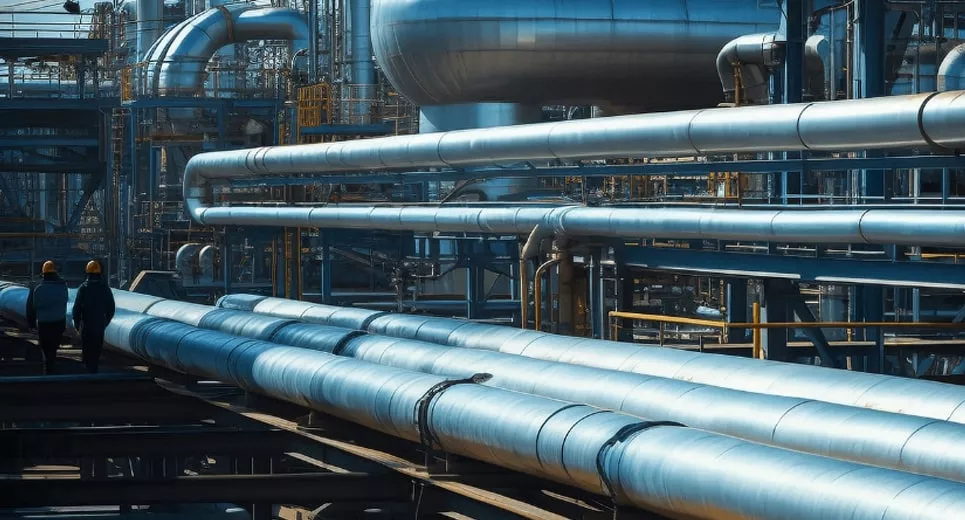
Upstream: separation, cooling and process heating
In upstream production — on platforms and at field facilities — plate exchangers handle duties such as cooling produced fluids, interstage compressor cooling, glycol and amine system heating/cooling, and process heating. Space and weight are at a premium offshore, so the compact plate exchanger is preferred over bulky shell-and-tube. The fluids can be sour, chloride-bearing or high-pressure, so material selection (often titanium or high alloys) and the choice between gasketed and welded designs are critical. SHPHE configures each unit to the specific upstream conditions, balancing compactness, corrosion resistance and the safety of leak-free operation.
Midstream & LNG: high-pressure and cryogenic duties
LNG and midstream processing involves high pressures and cryogenic temperatures that push beyond ordinary exchangers. For compact high-pressure and cryogenic heat exchange, the PCHE (printed circuit heat exchanger) — with its diffusion-bonded block — is often the enabling technology, handling extreme pressure in a fraction of the space. Welded plate designs also serve many midstream duties. The priorities here are pressure capability, compactness and integrity, since leaks in LNG service are unacceptable. SHPHE's PCHE and welded platforms are engineered for these demanding conditions.
Downstream: refinery and petrochemical duties
In refining and petrochemicals, plate exchangers serve as interchangers (recovering heat between process streams), condensers, coolers and process heaters. High efficiency and close temperature approach let them recover more heat than shell-and-tube, improving energy efficiency — increasingly important for cost and carbon. Aggressive and high-temperature process fluids drive material and design choices, with welded (HT-Bloc) units handling the higher-pressure, higher-temperature duties beyond the gasketed envelope. Across the refinery, replacing or supplementing shell-and-tube with compact plate exchangers frees space and cuts energy use.
Which plate exchanger type for which oil & gas duty?
| Duty | Best platform |
|---|---|
| Clean cooling / heating, moderate P/T | Gasketed plate |
| High pressure / temperature, aggressive media | HT-Bloc welded |
| Extreme pressure, LNG cryogenic | PCHE |
| Fouling / particle-laden streams | Wide-gap / TP welded |
Why is leak-free operation so important in oil & gas?
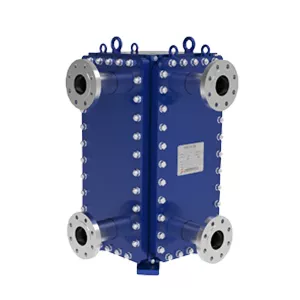
In an industry handling flammable and explosive hydrocarbons, an external leak is not merely an efficiency loss — it is a safety hazard with potentially catastrophic consequences. This is why the no-external-leakage characteristic of welded plate designs is so valued in oil & gas. By welding the plate pack rather than sealing it with gaskets, the exchanger removes the gasket as a potential leak path, containing the hydrocarbon safely even at high pressure. This safety benefit, combined with the higher pressure and temperature envelope welding provides, is a major reason welded plate exchangers — SHPHE's HT-Bloc and TP welded platforms — are increasingly specified for hydrocarbon duties over both gasketed plate units and traditional shell-and-tube. Where a gasketed unit is used for a cleaner, lower-risk service, it is chosen deliberately for its cleaning access, with the fluid and pressure kept within safe limits. Safety-led design is at the heart of every oil & gas heat-exchanger selection.
How do plate exchangers support energy efficiency and decarbonisation?
Beyond safety, plate exchangers help oil & gas plants meet tightening energy and carbon targets. Their high efficiency and close temperature approach let them recover more heat between process streams than shell-and-tube — for example as interchangers in a refinery — which directly cuts the fuel needed to reheat streams and lowers emissions. Their compactness also reduces the plot space and structural steel a plant needs, with the associated embodied-carbon and cost savings. As the industry invests in efficiency and decarbonisation, replacing or supplementing bulky, less efficient shell-and-tube exchangers with compact, high-recovery plate units is a practical, high-return measure. SHPHE's welded and PCHE platforms let refineries and processing plants capture this heat-recovery opportunity across a wide range of duties, turning an efficiency upgrade into both a cost saving and a step toward lower carbon operation.
Leak-safe, corrosion-resistant thermal solutions
SHPHE addresses the oil & gas industry's needs with tailored plate-heat-exchanger solutions. Because the sector handles flammable and explosive materials, SHPHE's designs are engineered with no risk of external leakage, ensuring safe operation, and with corrosion-appropriate metallurgy for the sour, chloride-bearing and aggressive fluids common in the industry. From compact, weight-saving units on upstream platforms, to PCHE cores for high-pressure LNG duties, to welded interchangers recovering heat in refineries, SHPHE matches the platform and materials to each specific duty. Certified to ASME, NB, CE, BV and SGS with 30+ patents since 2005 and exports to 20+ countries, SHPHE supplies quality plate heat exchangers across the global oil & gas value chain.
Source: SHPHE product information. See the oil & gas solutions page.
Offshore and space-constrained installations
Offshore platforms and modular facilities impose one overriding constraint that plate exchangers are ideally suited to meet: weight and space. Every tonne of topside weight and every square metre of deck carries a large cost, so a compact, lightweight plate exchanger that delivers the same duty as a bulky shell-and-tube is a significant advantage. Titanium plates further reduce weight while resisting seawater corrosion, making the titanium plate exchanger the standard for offshore seawater cooling. In these installations the compactness is not a convenience but an economic necessity, and it is one of the clearest reasons plate technology has displaced shell-and-tube in upstream and offshore duties. SHPHE engineers compact, corrosion-resistant units specifically for these weight- and space-critical environments, helping operators meet their layout and payload constraints without compromising thermal performance.
What material and design considerations matter most?
Two decisions dominate oil & gas selection. First, materials: sour service, chlorides and high temperatures often demand titanium, super-austenitic or nickel-alloy plates rather than standard stainless, and the choice must suit both fluids. Second, gasketed vs welded: flammable, high-pressure or aggressive duties usually call for welded designs that eliminate external leakage and lift the pressure/temperature envelope, while cleaner, lower-duty services can use gasketed units for easy cleaning. Getting these right — matched to the specific fluid and conditions — is what delivers safe, reliable, long-life operation in this demanding industry, and it is the core of SHPHE's custom-engineering approach.
As a specialist plate-heat-exchanger manufacturer, SHPHE (Shanghai Heat Transfer Equipment Co., Ltd.) custom-engineers oil & gas heat exchangers across upstream, LNG, refining and petrochemicals, backed by ASME/NB/CE/BV/SGS certification and 30+ patents.
From the wellhead to the petrochemical plant, the common thread is that oil & gas duties reward an exchanger matched precisely to the fluid, pressure, temperature and safety requirement. That is exactly the fluid-and-duty-led engineering SHPHE applies to every unit it supplies to the sector, backed by international certification and decades of experience.
A final consideration is the operating environment itself. Oil & gas facilities can be remote, offshore, or in harsh climates, and the exchanger must be reliable where servicing is difficult and costly. This raises the value of leak-free welded designs, corrosion-resistant metallurgy that avoids premature failure, and — increasingly — condition monitoring such as SHPHE Smart Eye that predicts maintenance before a problem forces an unplanned shutdown. Specifying for reliability in the actual operating environment, not just the thermal duty, is what keeps a critical hydrocarbon process running safely and continuously between planned turnarounds, which in a remote or offshore setting is often the difference between a profitable operation and a costly one.
Send SHPHE your duty, fluids and conditions for a leak-safe, corrosion-appropriate design.
Consult our engineers →| Duty | Type | Material |
|---|---|---|
| Crude / product cooling | Welded / gasketed | 316L / duplex |
| Sour / H₂S service | Welded plate | Corrosion-resistant alloy |
| Offshore seawater cooling | Gasketed / welded | Titanium |
| High-pressure gas | PCHE / welded | Stainless / alloy |
Frequently asked questions
Why are plate heat exchangers used in oil & gas?
For their high efficiency, compact size, corrosion resistance and ease of maintenance — and welded designs give no external leakage, which is essential for flammable, explosive media.
Which plate exchanger suits LNG duties?
The PCHE (printed circuit heat exchanger) is often used for compact, high-pressure and cryogenic LNG duties thanks to its diffusion-bonded, extreme-pressure block.
What plate material is used for sour or chloride service?
Titanium, 254 SMO or nickel alloys, depending on the chloride level and chemistry — standard stainless is often not sufficient for sour, chloride-bearing fluids.
Gasketed or welded for oil & gas?
Welded designs for flammable, high-pressure or aggressive duties (no external leakage, higher envelope); gasketed for cleaner, lower-duty services needing easy cleaning.
Can plate exchangers replace shell-and-tube in refineries?
Yes — compact plate exchangers recover more heat in less space, freeing plot area and cutting energy use compared with bulky shell-and-tube.
Sources & further reading: SHPHE product information; general oil & gas heat-exchanger practice. Material and design depend on the specific service — confirm with an engineered selection.