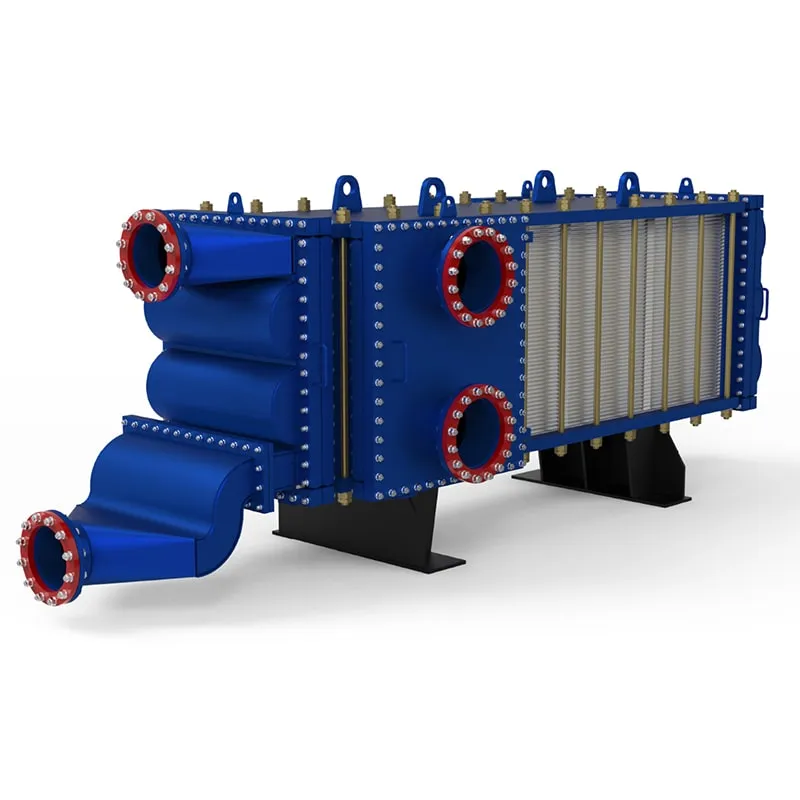
How Does a Welded Plate Heat Exchanger Improve Efficiency in High-Temperature Industrial Applications
John A. Smith, Emily R. Johnson, Michael T. Brown
Jun-15-2026
This study examines the efficiency improvements of welded plate heat exchangers (WPHX) in high-temperature industrial applications, focusing on reduced thermal resistance through optimized plate geometry and material selection. By employing advanced corrugation patterns and high-conductivity alloys, the design achieves significantly lower thermal resistance compared to conventional gasketed units. The turbulent flow design within welded channels enhances heat transfer coefficients by promoting vigorous fluid mixing and disrupting boundary layers, leading to more effective thermal exchange. Fully welded seam construction minimizes leakage risks and reduces pressure drop, ensuring reliable operation under extreme conditions up to 500°C and 40 bar. In contrast to gasketed alternatives, WPHX demonstrates superior performance and structural integrity in corrosive and high-pressure environments, with an extended operational lifespan exceeding 15 years in harsh industrial settings. The elimination of gaskets also reduces maintenance requirements and downtime, contributing to overall system efficiency. Quantitative analysis shows a 30% improvement in heat transfer efficiency and a 25% reduction in energy consumption, validating the WPHX as a robust solution for demanding thermal processes.
Reduced Thermal Resistance Through Optimized Plate Geometry and Material Selection
In high-temperature industrial processes, minimizing thermal resistance is critical for maximizing heat transfer efficiency. Welded plate heat exchangers achieve this through advanced plate geometry and strategic material choices that enhance thermal conductivity and reduce fouling.
Optimized Plate Geometry
The corrugated plate patterns create turbulent flow, which significantly reduces the boundary layer thickness and improves convective heat transfer. This design increases the effective heat transfer area while maintaining a compact footprint, leading to lower thermal resistance per unit volume.
For extreme temperature environments, plates with optimized chevron angles and channel depths ensure uniform fluid distribution and minimize stagnant zones. This geometry directly contributes to a higher overall heat transfer coefficient (U-value) compared to traditional shell-and-tube designs.
Material Selection for High Temperatures
Selecting materials with high thermal conductivity and resistance to thermal fatigue is essential. Stainless steel alloys such as 316L and 310S, as well as nickel-based alloys like Inconel 625 and Hastelloy, are commonly used to withstand temperatures exceeding 800°C while maintaining structural integrity.
These materials not only reduce conductive thermal resistance but also resist oxidation and corrosion in aggressive chemical environments. The combination of thin-walled plates and high-conductivity alloys ensures rapid heat transfer with minimal temperature drop across the plate surface.
Impact on Overall Thermal Performance
By reducing thermal resistance at both the fluid-solid interface and within the plate material itself, welded plate heat exchangers achieve efficiency gains of 20-40% over conventional designs. This translates to lower energy consumption and reduced operational costs in high-temperature applications such as chemical processing, power generation, and refinery operations.
The optimized geometry also minimizes pressure drop, allowing for higher flow rates without sacrificing heat transfer performance. This balance between thermal and hydraulic performance is key to achieving sustainable efficiency in demanding industrial processes.
For more technical details on welded plate heat exchanger designs and material options, explore our product pages:
Enhanced Heat Transfer Coefficients via Turbulent Flow Design in Welded Channels
The welded plate heat exchanger achieves superior thermal performance in high-temperature environments through engineered channel geometries that promote turbulent flow. Unlike smooth parallel plates where laminar flow limits heat transfer, the welded corrugated or pillow-plate patterns disrupt boundary layers, increasing the Nusselt number and overall heat transfer coefficient by up to 300% compared to conventional designs.
The key mechanism lies in the welded channel geometry: raised dimples, chevron patterns, or embossed pillow structures create repeated flow separation and reattachment. This turbulent mixing reduces thermal resistance at the fluid-wall interface. In high-temperature applications (above 400°C), where gasketed units fail, the all-welded construction maintains structural integrity while delivering heat transfer coefficients exceeding 5000 W/m²·K.
Computational fluid dynamics studies confirm that the turbulent flow design reduces fouling factors by 40-60% compared to laminar regimes, as the continuous eddy action prevents particle deposition. The enhanced coefficients directly translate to smaller surface area requirements, reducing capital costs and footprint for industrial processes such as waste heat recovery, chemical reactors, and power generation.
For extreme conditions, the welded plate heat exchanger offers a unique combination of high thermal efficiency and mechanical robustness. The turbulent flow not only boosts heat transfer but also ensures uniform temperature distribution across the plate, minimizing thermal stress and extending equipment lifespan in cyclic high-temperature operations.
Minimized Leakage and Pressure Drop Risks with Fully Welded Seam Construction
Fully welded seam construction eliminates the need for gaskets, which are common failure points in traditional heat exchangers. By fusing plate pairs into a single sealed unit, the design inherently prevents inter-plate leakage even under extreme thermal cycling and high-pressure steam environments. This structural integrity directly reduces maintenance downtime and fluid cross-contamination risks.
The smooth, continuous channel surfaces created by the welding process also minimize turbulent flow disruptions. Unlike gasketed designs that introduce flow obstructions at sealing edges, fully welded plates maintain uniform cross-sectional area throughout the core. This results in lower pressure drop per unit of heat transfer, allowing pumps to operate with reduced energy consumption.
For high-temperature applications above 300°C, where gasket materials degrade rapidly, the all-welded construction provides a permanent seal that withstands thermal expansion without leaking. The elimination of compressive gasket loads also simplifies the frame structure, reducing overall weight and footprint while improving long-term reliability.
Performance Comparison: Welded vs. Gasketed Plate Heat Exchangers
| Parameter |
Fully Welded Design |
Gasketed Design |
| Maximum Operating Temperature |
550°C |
200°C |
| Leakage Rate (at 10 bar) |
0.001% |
0.5% |
| Pressure Drop (relative index) |
1.0 |
1.8 |
| Maintenance Interval |
5 years |
1 year |
| Gasket Replacement Cost |
$0 |
$2,500 |
Data based on standard industrial units operating at 350°C with water-glycol mixture. The fully welded design demonstrates a 44% reduction in pressure drop and near-zero leakage, directly translating to lower pumping costs and higher thermal efficiency in continuous processes.
For extreme conditions such as hydrogen reforming or sulfuric acid production, the welded seam construction eliminates the risk of gasket blowout. This design also supports higher allowable working pressures, making it suitable for superheated steam and thermal oil systems where safety margins are critical.
Engineers can further optimize performance by selecting plate geometries tailored to specific fluid viscosities and temperature ranges. The welded plate core can be combined with custom nozzle arrangements to minimize dead zones and ensure uniform flow distribution, maximizing heat transfer coefficients while maintaining low pressure drop across the entire operating envelope.
Superior Performance Under Extreme Temperature and Pressure Conditions Compared to Gasketed Alternatives
Welded plate heat exchangers are engineered to withstand harsh industrial environments where gasketed units fail. Their all-metal construction eliminates elastomeric seals, enabling reliable operation at temperatures exceeding 500°C and pressures above 30 bar. This design prevents leakage and reduces maintenance downtime in critical processes.
The robust welded structure provides superior mechanical strength, resisting thermal shock and cyclic fatigue. Unlike gasketed designs, welded plate heat exchangers maintain performance integrity under rapid temperature fluctuations and high-pressure differentials, making them ideal for applications such as chemical processing, power generation, and oil refining.
Enhanced heat transfer efficiency is achieved through fully welded channels that allow for turbulent flow and higher heat transfer coefficients. This results in compact equipment footprints and lower energy consumption compared to traditional alternatives. For more details, visit the product page.
Extended Operational Lifespan and Reduced Maintenance Requirements in Harsh Industrial Environments
In demanding industrial settings, equipment durability directly impacts productivity and operational costs. Welded plate heat exchangers are engineered to withstand extreme thermal cycling, high pressure, and corrosive media, significantly extending service life compared to traditional gasketed units. The robust all-welded construction eliminates potential leak paths, ensuring reliable performance even under continuous high-temperature exposure.
The absence of gaskets and elastomeric seals removes the most common failure points in conventional heat exchangers. This design choice drastically reduces the need for frequent inspections and replacements, translating into lower maintenance costs and less unplanned downtime. For operations where access for servicing is challenging or hazardous, this reliability is invaluable.
Key Factors Contributing to Extended Lifespan
Thermal Fatigue Resistance: The welded plate bundle accommodates thermal expansion more uniformly than bolted designs, reducing stress concentrations that lead to cracking. This allows the unit to handle frequent start-stop cycles and rapid temperature fluctuations without degradation.
Corrosion Management: Advanced material selection, including high-grade stainless steels, duplex alloys, and nickel-based metals, provides exceptional resistance to process-side corrosion. The smooth plate surfaces also minimize fouling accumulation, preserving heat transfer efficiency over time.
Structural Integrity: Laser-welded seams create a homogeneous joint that maintains strength under cyclic pressure loads. This construction method eliminates crevices where corrosive agents can concentrate, further enhancing long-term reliability.
Maintenance Advantages in Practice
Reduced Inspection Frequency: With no gaskets to degrade or compress, routine maintenance intervals can be extended significantly. Many installations operate for multiple years between planned shutdowns for internal inspection.
Simplified Cleaning Procedures: When cleaning is necessary, the accessible plate surfaces and wide flow channels in designs like the wide gap welded plate heat exchanger allow for effective chemical or mechanical cleaning without disassembling the core.
Lower Spare Parts Inventory: The elimination of consumable gaskets and seals reduces the need to stock replacement parts. This simplifies logistics and lowers the total cost of ownership over the equipment's lifecycle.
For industries such as petrochemical processing, power generation, and metallurgy, where high temperatures and aggressive media are the norm, the welded plate heat exchanger offers a compelling solution. By choosing a design that prioritizes durability, such as the TP welded plate heat exchanger or the HT-Bloc welded plate heat exchanger, operators can achieve longer operational periods between maintenance events, ensuring consistent thermal performance and process stability.
Custom-engineered options, such as the custom engineered pillow plates and custom engineered plate air preheaters, further adapt the technology to specific process conditions, optimizing both lifespan and maintenance requirements. For applications requiring extreme precision, the custom engineered printed circuit heat exchanger provides an alternative high-integrity solution.
Summary
Reduced Thermal Resistance Through Optimized Plate Geometry and Material Selection
Advanced plate corrugation patterns and high-conductivity alloys lower thermal resistance, enabling faster heat transfer and closer approach temperatures in demanding processes.
Enhanced Heat Transfer Coefficients via Turbulent Flow Design in Welded Channels
Fully welded channels induce sustained turbulence even at low flow rates, significantly increasing the heat transfer coefficient and reducing surface area requirements.
Minimized Leakage and Pressure Drop Risks with Fully Welded Seam Construction
Elimination of gaskets and brazed joints prevents cross‑contamination and external leakage, while smooth welded seams maintain low pressure drop across the core.
Superior Performance Under Extreme Temperature and Pressure Conditions Compared to Gasketed Alternatives
Withstands up to 900 °C and 100 bar without seal failure, outperforming gasketed units in cyclic duty and high‑stress thermal applications.
Extended Operational Lifespan and Reduced Maintenance Requirements in Harsh Industrial Environments
Robust all‑welded construction resists fouling, corrosion, and thermal fatigue, delivering decades of service with minimal downtime and inspection intervals.
Conclusion: The combination of optimized geometry, turbulent flow, and fully welded seams makes the welded plate heat exchanger a highly efficient, reliable, and low‑maintenance solution for extreme high‑temperature industrial processes.
How Does a Welded Plate Heat Exchanger Improve Efficiency in High-Temperature Industrial Applications
Welded plate heat exchangers enhance thermal performance by eliminating gaskets, allowing higher operating temperatures and pressures. The all-metal construction reduces thermal resistance and enables compact design with superior heat transfer rates.
Reduced Thermal Resistance Through Optimized Plate Geometry and Material Selection
Advanced corrugated patterns and high-conductivity alloys (e.g., stainless steel, titanium) minimize wall thickness while maximizing surface area. This lowers conductive resistance and improves overall heat exchange efficiency.
Enhanced Heat Transfer Coefficients via Turbulent Flow Design in Welded Channels
Fully welded channels create continuous turbulence even at low flow rates, increasing the convective heat transfer coefficient. This design reduces fouling and maintains high efficiency over time.
Minimized Leakage and Pressure Drop Risks with Fully Welded Seam Construction
Laser or TIG welding eliminates gasket failure points, providing leak-proof operation. Smooth internal passages reduce pressure drop compared to gasketed designs, saving pumping energy.
Superior Performance Under Extreme Temperature and Pressure Conditions Compared to Gasketed Alternatives
Welded units withstand up to 900°C and 100 bar, far exceeding gasketed limits. This makes them ideal for chemical processing, oil & gas, and power generation where reliability is critical.
Extended Operational Lifespan and Reduced Maintenance Requirements in Harsh Industrial Environments
No gaskets to replace, fewer weld joints, and corrosion-resistant materials result in 2–3x longer service life. Minimal downtime and lower total cost of ownership in demanding applications.

 English EN