
Printed Circuit Heat Exchangers are built to handle the toughest high-pressure environments found in industries like LNG and offshore processing. Their advanced design uses photo-chemically etched microchannels and state-of-the-art diffusion bonding for high durability and efficiency. The table below shows how these exchangers stand out compared to traditional models:
Feature | Printed Circuit Heat Exchangers | Conventional Heat Exchangers |
|---|---|---|
Size | Up to 85% smaller and lighter | Larger and heavier |
Pressure Handling | Up to 1,250 bar | Lower pressure ratings |
Material | All-stainless-steel construction | Less robust materials |
Durability | High durability | Prone to fatigue failures |
Printed Circuit Heat Exchangers (PCHEs) are up to 85% smaller and lighter than traditional models, making them ideal for space-constrained environments.
PCHEs can handle pressures up to 1,250 bar, ensuring reliability in high-pressure applications like LNG and offshore processing.
The diffusion-bonded structure of PCHEs eliminates weak points, enhancing safety and reducing the risk of catastrophic failures.
Microchannel designs in PCHEs maximize heat transfer efficiency, maintaining performance even with fluctuating flow rates.
Advanced materials like stainless steel and titanium provide excellent corrosion resistance, ensuring long-term durability in harsh conditions.
High-pressure heat transfer systems face unique technical and operational challenges. These challenges are especially important in industries such as LNG, offshore, and hydrocarbon processing, where equipment must perform reliably under extreme conditions.
Mechanical stress is a major concern in high-pressure heat exchangers. Tube-to-tubesheet joints often experience complex stress states due to pressure fluctuations. This can lead to failures, especially when design standards are based on lower-pressure data. The table below shows common types of mechanical stress and their consequences:
Stress Type | Description | Consequence |
|---|---|---|
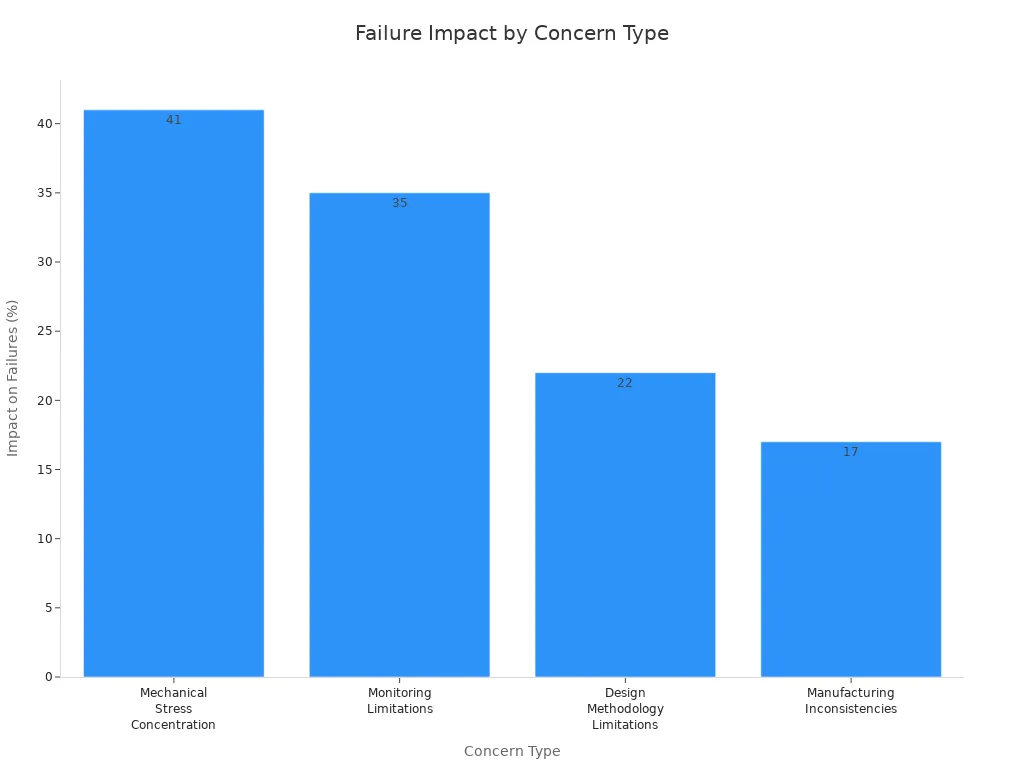
Stress concentration at joints | Tube-to-tubesheet joints experience complex stress states due to pressure fluctuations. | Approximately 41% of failures originate at these points, indicating design inadequacies. |
Mechanical stress and fatigue | Caused by thermal cycling, vibration, and pressure fluctuations. | Leads to tube failure; mitigated by proper design, advanced materials, and regular inspections. |
Proper tube support and vibration dampening can help reduce mechanical stress. Advanced materials with high fatigue resistance also extend the life of heat exchanger tubes.
Efficiency loss is another challenge in high-pressure environments. As air flow rates increase, efficiency drops sharply. For example, at a low air flow rate of 1.8 × 10⁻³ kg/s, efficiency can reach 96%. At a higher flow rate of 47 × 10−3 kg/s, efficiency falls to 15%. The table below illustrates this trend:
Air Flow Rate (kg/s) | Efficiency (%) |
|---|---|
1.8 × 10⁻³ | 96 |
47 × 10−3 | 15 |
Three modules (1.8 × 10⁻³) | 93 |
Three modules (47 × 10−3) | 41 |
Printed Circuit Heat Exchanger designs help maintain high efficiency even as operating pressures and flow rates fluctuate.
Safety and reliability are critical in high-pressure heat transfer systems. Material degradation, corrosion, and monitoring limitations can lead to unexpected failures. Conventional non-destructive testing methods often miss early signs of failure, resulting in 35% of tube failures being detected only after catastrophic events. The chart below shows the impact of different safety concerns:
Addressing these challenges is vital for industries that depend on reliable heat transfer under high pressure. Advanced solutions like Printed Circuit Heat Exchanger technology offer improved mechanical integrity, efficiency, and safety.

The diffusion-bonded structure forms the backbone of SHPHE's Printed Circuit Heat Exchanger. This process joins metal plates at the atomic level, creating a solid-state bond. The result is a heat exchanger with superior mechanical integrity. Leak-proof operation is achieved because there are no welds or joints that can fail under high pressure. This structure withstands extreme mechanical stress and pressure fluctuations. The design ensures long-term reliability in demanding environments such as LNG processing and offshore platforms.
SHPHE's diffusion bonding technology eliminates weak points found in conventional exchangers. This approach increases safety and reduces the risk of catastrophic failures.
Microchannels etched into the plates of the Printed Circuit Heat Exchanger maximize heat transfer. These channels create a large surface area for thermal exchange. Computational fluid dynamics (CFD) modeling has shown that the shape and arrangement of microchannels impact performance. Different cross-sectional geometries improve heat transfer rates and reduce thermal resistance.
Study | Findings |
|---|---|
Li et al. | Trapezoidal cross section outperformed triangular cross section in heat transfer capabilities. |
Tamayol and Bahrami | Hyper elliptical and regular polygonal cross sections were analyzed for performance. |
Alfaryjat et al. | Investigated hexagonal, circular, and rhombic cross sections. |
Tilak and Patil | Significant differences in channel wall temperatures and convective heat transfer coefficients were observed due to cross-sectional geometry. |
Chai et al. | Periodic variance in cross section reduced thermal resistance, especially at higher pumping powers. |
Ghaedamini et al. | Similar periodic designs showed increased heat transfer with slight pressure drop increases. |
Ahmed et al. | Higher symmetry in periodic designs led to better heat transfer rates, while complex eddy interactions affected performance negatively. |
Microchannel arrays allow the Printed Circuit Heat Exchanger to maintain high efficiency even as flow rates and pressures change. This technology supports energy recovery and operational excellence.
The compact design of SHPHE's Printed Circuit Heat Exchanger offers significant advantages. These exchangers are up to 85% smaller in volume compared to traditional shell-and-tube models. The reduced size and weight are crucial for modular and offshore installations. Industries with strict weight and volume constraints, such as marine engineering and aerospace, benefit from this miniaturization.
SHPHE PCHEs require less space, making them ideal for crowded platforms.
The small footprint leads to lower installation costs.
High thermal performance is achieved with less material.
Maintenance downtime decreases because the design is easy to access and service.
Lower operational costs enhance safety and reliability.
The compactness aligns with industry trends toward downsizing equipment. Printed Circuit Heat Exchanger technology supports efficient use of space and resources.
SHPHE uses advanced materials to construct its Printed Circuit Heat Exchanger. Austenitic stainless steel and titanium provide exceptional resistance to corrosion and thermal fatigue. These materials perform well in harsh environments, including exposure to seawater and aggressive chemicals. The manufacturing process includes high-precision microchannel etching and CFD modeling. This ensures each unit meets strict quality standards.
SHPHE's commitment to quality is demonstrated by certifications such as ISO9001, ISO14001, and OHSAS18001. These certifications guarantee reliability and performance in every Printed Circuit Heat Exchanger.
The combination of premium alloys and rigorous quality assurance makes SHPHE PCHEs a trusted solution for high-pressure heat transfer applications.
Printed Circuit Heat Exchanger technology has become a preferred choice in LNG and offshore industries. These environments demand equipment that can handle high pressures and limited space. The compact size of PCHEs allows for easy installation on crowded offshore platforms. Their self-supporting structures maintain stability even in harsh marine conditions. Operators value the ability to quickly connect or disconnect modules, which helps reduce downtime during maintenance.
High thermal efficiency is achieved through microchannel layouts and counter-current flow.
PCHEs are rated for pressures well above 100 bar, making them suitable for extreme offshore and LNG conditions.
The compact design reduces pressure drop and enhances performance.
Power plants and hydrocarbon processing facilities also benefit from PCHEs. These exchangers are used in hydrogen production, refining, and gas processing. Their adaptability to changing environmental conditions ensures reliable operation. In modular settings, PCHEs optimize the use of distributed energy resources and minimize operational impact.
Benefit Description | Details |
|---|---|
Modular Design | Systems come in various sizes and can be quickly connected or removed. |
Functional Redundancy | If one unit fails, the system continues to operate efficiently. |
Efficient Resource Use | Design supports optimal use of energy resources in demanding settings. |
Several real-world examples highlight the advantages of PCHEs:
Gas processing and liquefaction plants use PCHEs for efficient heat recovery under high-pressure conditions.
Offshore production facilities rely on the compact design for space-constrained rigs.
Hydrogen production and refining operations specify PCHEs for their reliability in demanding applications.
PCHEs deliver consistent performance, reduce installation costs, and improve safety in ultra-high-pressure environments.
Printed Circuit Heat Exchanger technology provides a complete answer for high-pressure heat transfer needs. Its advanced structure, high efficiency, and compact size support safe and reliable operation in tough environments. SHPHE’s quality and certifications show proven results in the field. As industries focus on net-zero goals, new materials and digital tools will make these exchangers even more important for energy and emissions solutions.
A PCHE is a compact heat exchanger. It uses many small channels etched into metal plates. These channels help transfer heat between fluids at high pressure and temperature.
SHPHE PCHEs are used in LNG plants, offshore platforms, and hydrocarbon processing. They also work well in hydrogen production and power generation.
Diffusion bonding joins metal plates without welds or joints. This process creates a solid structure. It reduces the risk of leaks and failures under high pressure.
SHPHE uses premium alloys like austenitic stainless steel and titanium. These materials resist corrosion and thermal fatigue, even in harsh environments.
PCHEs are smaller, lighter, and more efficient. They handle higher pressures and temperatures. Their design also lowers installation and maintenance costs.



 English EN