
A welded plate heat exchanger transfers heat between separate fluid passages formed by metal plates joined using a specified welding construction. It can combine a compact thermal core with a pressure and temperature envelope suited to the service, but its access, cleaning method and operating limits depend on the particular design.
Hot and cold streams flow through separate passages, exchanging heat through the intervening plate material. Plate geometry and the selected flow arrangement influence mixing, heat transfer and pressure drop.
A larger surface area or higher fluid-side coefficient does not guarantee a better plant result. Available pumping head, fouling, approach temperatures, material compatibility and maintenance can determine the practical selection.
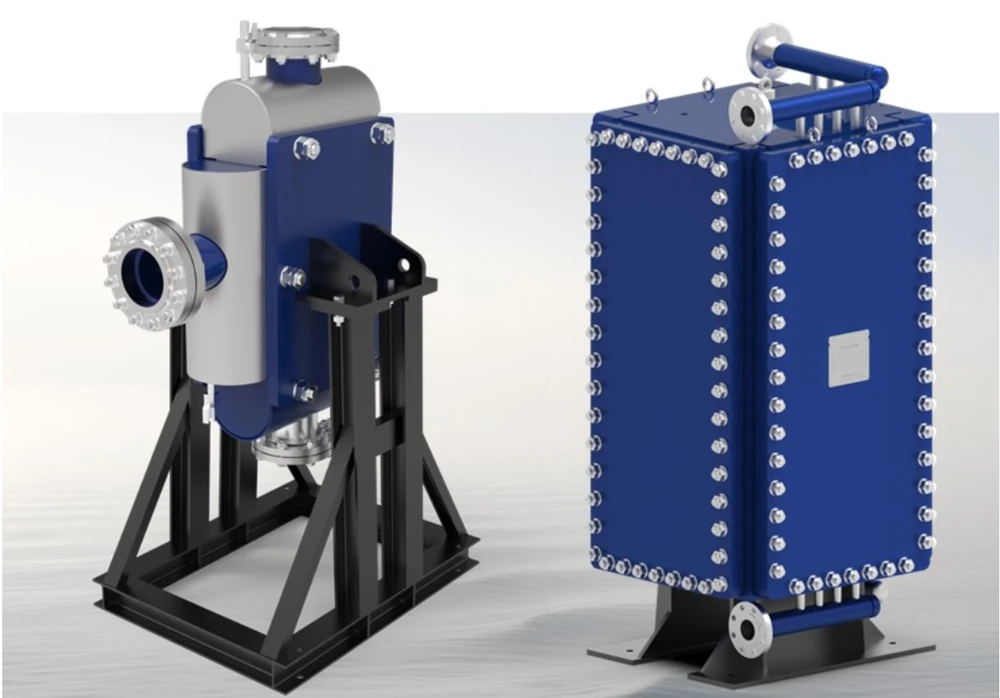
| Product direction | Construction or selection focus | Maintenance distinction |
|---|---|---|
| HT-Bloc welded plate heat exchanger | Welded plate core with configuration-specific cover access | Covers can provide access; individual welded plates do not separate |
| TP welded plate heat exchanger | Welded plate pack within the selected shell or enclosure | Access depends on the supplied enclosure arrangement |
| wide-gap welded plate heat exchanger | Passages selected for the defined viscous or solids-bearing medium | Cleaning route and inlet protection remain application-specific |
| printed circuit heat exchanger (PCHE) | Etched channels joined by diffusion bonding, a different solid-state joining route | The bonded core does not open into removable plates |
These products should not be assigned identical pressure ratings, materials or channel gaps. PCHE's diffusion-bonded construction is also different from a conventional fusion-welded plate pack.
It can be useful when the service benefits from removing elastomeric interplate gaskets, when compact process heat recovery is important or when the selected channel design addresses a particular fluid constraint. Cover and connection seals can remain elsewhere in the equipment.
For a compatible utility liquid that needs frequent individual-plate inspection, a gasketed plate heat exchangers may be the more practical arrangement. For heavy solids or fibers, passage design can be more important than the general choice between a gasketed and welded core.
Stainless steels, duplex alloys, titanium and nickel alloys have different applications. Chemistry, concentration, temperature, impurities and cleaning conditions all affect selection. Nickel alloys are not chosen simply because of a generic claim of superior thermal conductivity, and titanium is not universally compatible with every corrosive liquid.
Include weld and seal compatibility in the review. The selected alloy does not remove the need for qualified manufacturing, inspection and service monitoring.
Specify both-side fluid conditions, required outlet temperatures and allowable pressure drop. Review normal, minimum and maximum loads and the expected condition of the surfaces. Counterflow or multi-pass arrangements must be assessed for the actual duty rather than treated as automatically optimal.
For a replacement study, compare complete installed weight, support requirements, piping changes and maintenance clearance. A core's dimensions alone do not establish the cost or practicality of a revamp.
Some designs permit mechanical channel access through covers; other cores require compatible chemical cleaning and stronger upstream cleanliness control. Establish that route before selecting the equipment.
Do not assume that a welded exchanger can be repaired by replacing individual plates at site. Suspected leakage or plate damage should be assessed using the manufacturer's approved inspection and repair route for the actual construction.
Fluid composition, phase behavior, solids or fibers and viscosity over the temperature range.
Operating and design pressures and temperatures on both circuits.
Heat duty, flow cases and allowable pressure loss.
Fouling history, cleaning requirements and the required inspection access.
Code, materials, installation and documentation constraints.
With these inputs, SHPHE can assess which plate construction merits a detailed proposal and which trade-offs need to be resolved. The result is a duty-specific selection rather than an assumption that every welded plate exchanger is suitable for every industrial service.



 English EN