
Industrial boiler and furnace exhaust gases carry a substantial amount of recoverable thermal energy that often goes to waste. A plate type air preheater captures this heat and returns it to the combustion air stream, which means your burners work less, fuel consumption drops, and emissions shrink. This article walks through how these systems work, where they fit, and what you can realistically expect in terms of efficiency gains and payback.
A Plate Air Preheater is a gas-to-gas heat exchanger built from a stack of thin corrugated metal plates. These plates create separate passages: hot flue gas flows through one set of channels, and incoming cold combustion air flows through the adjacent ones. Heat passes through the metal wall from the exhaust side to the air side without the two gas streams ever mixing.
The corrugations in the plates are not just for structural strength. They create turbulence in the gas flow, which improves the heat transfer coefficient significantly compared to a smooth tube. The result is a compact unit that can handle large gas volumes while recovering heat that would otherwise leave through the stack.
What makes this design different from a rotary or tubular preheater is the fully welded plate matrix. There are no rotating parts, no seals to leak, and no packing to replace. The welded construction also means you can use it with flue gas that contains sulfur compounds or other corrosive elements, as long as the material grade is selected properly.
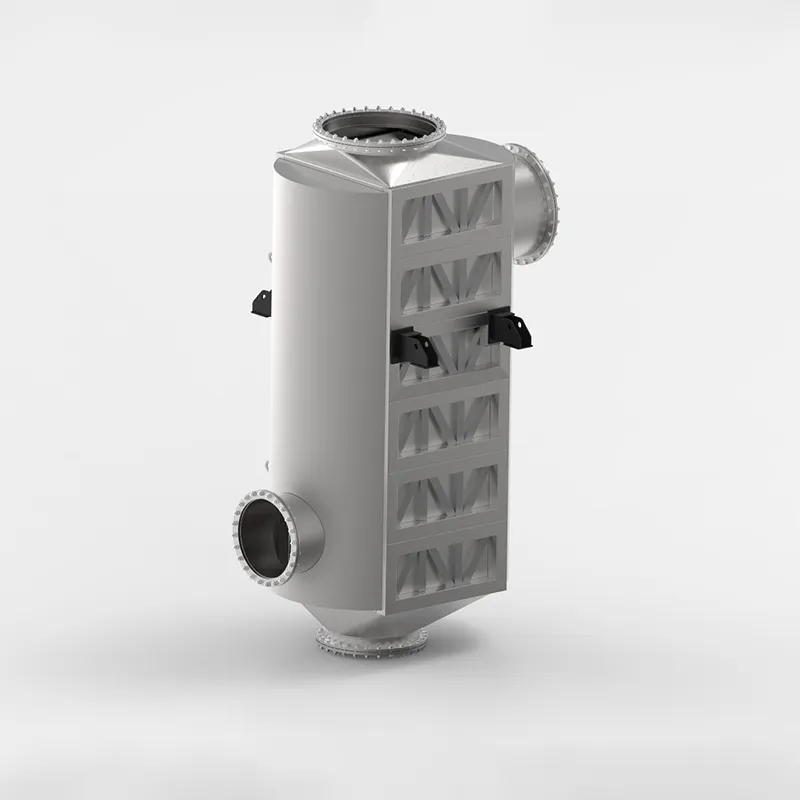
The operating principle is straightforward. Raw flue gas at high temperature enters one side of the unit and travels through the dedicated channels. As it moves along the plate surface, its heat is conducted through the thin metal wall into the cooler process air on the other side. The heated air then goes to the burner or furnace, which means less fuel is needed to reach the same flame temperature.
The flow arrangement can be countercurrent or crossflow, depending on your site layout and temperature targets. Countercurrent flow gives the highest thermal recovery because the temperature difference between the two streams stays more consistent along the length of the unit.
A key engineering detail is the modular block structure. Instead of one giant welded assembly, the unit is built from smaller standardized blocks that are stacked and connected on site. This makes transport easier, simplifies installation in tight spaces, and allows individual blocks to be isolated for inspection or replacement later without shutting the whole plant down.
There is a well-established relationship in boiler engineering: for every 18°C reduction in exhaust gas temperature, boiler efficiency improves by roughly 1%. That means if your stack temperature is currently sitting at 180°C and you bring it down to 126°C, you gain about 3% efficiency. On a large industrial boiler firing continuously, that translates directly into lower fuel bills.
Let us put some real numbers behind this. A mid-sized industrial boiler consuming 10,000 kW of fuel energy will see a 3% efficiency gain as roughly 300 kW of fuel savings. Over 8,000 operating hours per year, that is about 2,400 MWh of fuel energy avoided. At current natural gas prices, the annual savings can reach well into six figures in most markets.
Beyond the direct fuel saving, there is an emissions angle. Burning less fuel means less CO₂, SO₂, and NOx leaving your stack. For plants subject to carbon reporting or emissions trading, this adds a secondary financial benefit on top of the energy saving.
Not all flue gas streams are the same. If you are burning natural gas, the sulfur content is low and the corrosion risk is manageable. But if your fuel contains sulfur, the flue gas can drop below the acid dew point in the cold end of the preheater, leading to severe corrosion.
The engineering solution is a temperature-graded material strategy. The hot end of the unit can use standard carbon steel or 304 stainless, while the cold end, where condensation is more likely, gets fitted with higher alloys like 310S or Corten-A. This zoning approach keeps the upfront cost down without sacrificing service life where it matters most.
Plate thickness typically ranges from 0.6 mm to 2.0 mm. Thinner plates transfer heat more readily, but thicker plates offer more corrosion allowance. The right choice depends on your gas chemistry and how long you plan to run between turnarounds.
Design temperature capability goes up to 800°C, and the maximum operating pressure is 6 bar. For most boiler and furnace applications, this is well within the required envelope.
Oil and Gas: Refinery furnaces and process heaters run hot and run continuously. Recovering heat from their exhaust streams cuts fuel gas consumption and helps meet emissions targets. The welded plate construction handles the sulfur-bearing flue gas that is typical when processing heavier crude fractions.
Chemical Processing: Many chemical plants operate fired heaters for endothermic reactions or for steam generation. The preheater fits into the existing ductwork without major modifications, and the modular block design means you can add capacity later if your process expands.
Metallurgy: Alumina refineries and mining operations often have large furnaces with dirty exhaust. The self-cleaning plate geometry prevents soot buildup, so thermal performance stays consistent even with particulate-laden gas.
The common thread across these industries is the need for reliable, continuous operation. A Plate Type Air Preheater has no rotating machinery, so there is less that can fail during operation.
The pressure drop across a plate preheater is lower than you might expect. The corrugated channels are designed to keep gas velocity moderate, which means your existing draft fans can often handle the added resistance without needing an upgrade. This saves capital cost and keeps parasitic power consumption down.
The plate geometry also promotes self-cleaning. Turbulent flow near the plate surface discourages soot from settling, so the heat transfer surface stays clean for longer. When fouling does eventually occur, the modular design lets you isolate and clean one block at a time rather than taking the whole unit offline.
Noise is another consideration. Rotary preheaters generate mechanical noise from the drive motor and seals. A static plate unit runs silently, which improves the working environment for plant personnel.
If you have an existing boiler without any heat recovery on the exhaust, adding a plate air preheater is often the most cost-effective efficiency upgrade available. The unit sits in the flue gas duct between the economizer (if present) and the stack.
The compact footprint is a major advantage here. Because the corrugated plate design packs a large heat transfer area into a small volume, the preheater can fit into spaces where a tubular unit would not. This makes it viable for brownfield sites where space is tight.
Installation typically takes a few days of ductwork modification and lifting the modular blocks into place. The pre-tested modules are sealed together on site, so there is no on-site welding of the heat transfer surface.
Maximum heat transfer area: 40,000 m² per unit
Plate thickness: 0.6 – 2.0 mm
Design temperature range: -20°C to 800°C
Maximum design pressure: 6 bar
Available plate materials: 304, 316L, 2205, 310S, 904L, Corten-A
Manufacturing certifications: ASME, NB, CE, BV, SGS
The payback period for a plate air preheater depends on your fuel cost, operating hours, and the temperature drop you can achieve. In most industrial settings, the fuel savings alone pay for the equipment within 12 to 24 months. When you factor in the emissions reduction benefits and the extended life of downstream equipment (because flue gas temperatures are lower), the return improves further.
Maintenance costs are modest. There are no moving parts to lubricate or replace. The main activity is periodic inspection of the plate surfaces and cleaning if the gas stream carries heavy particulates. Because individual blocks can be swapped out independently, you avoid the capital hit of replacing the entire unit if one section develops a leak after many years of service.
For plants with decarbonization targets, the emission reduction is immediate and verifiable. Lower fuel consumption shows up directly in your Scope 1 emissions inventory, which helps with regulatory reporting and sustainability commitments.
If your boiler or furnace exhaust temperature is above 150°C and you are not already recovering heat from it, there is almost certainly an economic case for a plate air preheater. The fuel savings are predictable, the technology is proven, and the modular welded construction means you get a long service life without the maintenance headaches of rotary alternatives.
The key is getting the design right for your specific gas chemistry and temperature profile. That means proper material selection for the cold end, correct flow arrangement, and a layout that fits your existing ductwork. When those details are handled correctly, the unit will run for decades and quietly pay for itself many times over.



 English EN