
For offshore crude-oil cooling, a welded plate exchanger must do more than fit into a small footprint. It must accommodate the actual crude composition, control pressure loss and provide a workable cleaning route. HT-Bloc combines a welded plate pack with removable cover arrangements that can be useful when those requirements are assessed together.
Offshore crude may contain water, salts, suspended particles, wax and asphaltenes. Heating, desalting and cooling duties occur at different locations in the process, so the cooler datasheet should describe the stream at the actual exchanger inlet rather than untreated well-fluid properties alone.
The proposed cooling medium also matters. Freshwater or a glycol-water circuit creates a different materials and fouling assessment from direct seawater service. Both sides need their own composition, pressure, temperature and contamination information.

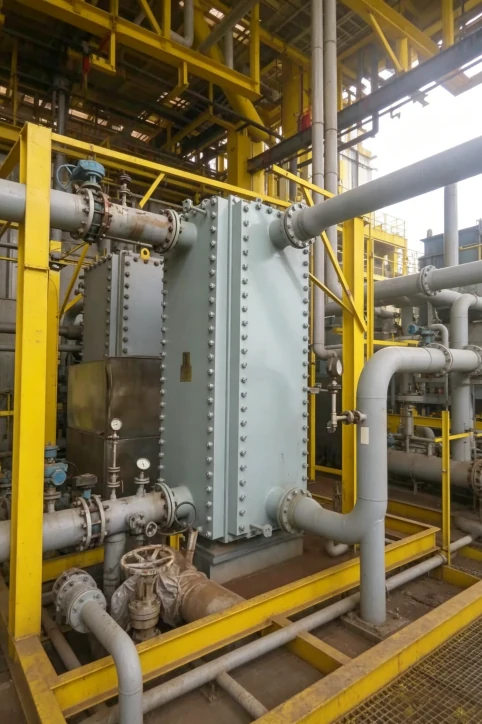
The HT-Bloc welded plate heat exchanger uses welded heat-transfer channels inside an enclosure with configuration-specific removable covers. Welding removes elastomeric interplate gaskets from the heat-transfer core. The complete exchanger may still contain cover or connection seals, so “welded core” should not be taken to mean that every joint is seal-free.
Where the supplied arrangement provides channel access, removable covers can support inspection and approved mechanical cleaning. The benefit is realized only if the installed piping and surrounding structure leave enough space to remove covers and reach the passages.
| Issue | What to establish | Design implication |
|---|---|---|
| Wax or asphaltene deposition | Crude properties and temperature-dependent behavior | Review wall temperatures and operating cases |
| Entrained solids | Particle size, concentration and upset carryover | Review passage geometry and upstream protection |
| Corrosion | Water chemistry, chlorides, sulfur species and temperature | Select plate and seal materials for the complete medium |
| Turndown operation | Minimum flow and allowable temperature range | Check distribution, settling tendency and control response |
Corrugated channels can promote mixing and wall shear, but increasing velocity indefinitely is not a fouling solution. The thermal design has to balance heat transfer, available pumping head and the wear potential of any suspended material.
A compact vertical core may reduce the equipment footprint, while the complete offshore installation still needs supports, pipe clearances, cover-removal space and lifting access. Compare dry weight, operating weight and maintenance arrangements on a consistent basis when reviewing an alternative to shell-and-tube equipment.
Specify the required heat duty and pressure drop at the agreed operating points, along with design conditions, inspection requirements and fluid-separation integrity checks. After commissioning, retain the clean baseline and trend performance at comparable conditions before deciding that a thermal change is caused by fouling.
For a new offshore crude-oil cooler or revamp, provide the crude assay relevant to the service, cooling-medium analysis, layout drawings and maintenance strategy. SHPHE can evaluate the HT-Bloc configuration against those constraints rather than relying on an unsupported “zero leakage” or universal run-length promise.



 English EN