
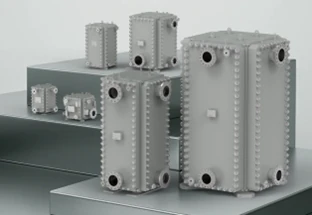
HT-Bloc combines a welded plate heat-transfer core with an enclosure designed to provide channel access through removable covers. Understanding that construction is the starting point for evaluating its thermal performance, maintenance route and manufacturing quality in a process application.
The HT-Bloc welded plate heat exchanger plate pack contains the alternating fluid passages. Welded interplate connections remove elastomeric gaskets from that part of the heat-transfer core. The enclosure, covers, nozzles and their seals form the rest of the equipment's pressure boundary.
This distinction prevents two incorrect assumptions: that a welded core makes every joint seal-free, or that removing a cover allows the welded pack to open like a gasketed plate exchanger. Maintenance access must be assessed from the supplied construction.
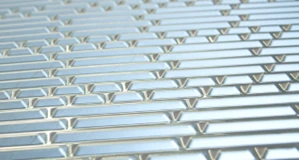
Corrugated passages promote fluid mixing and can increase the fluid-side heat transfer coefficient. That benefit is accompanied by hydraulic resistance. A useful calculation balances the required heat duty with the allowable pressure drop on both circuits.
Pass arrangements and distribution can be selected for unequal flow rates or a close temperature approach. The achieved approach depends on the fluid properties, flow rates, heat-transfer area and configuration; it is not a fixed value supplied by the product name.
| Parameter in the supplied product literature | Published range | How to use it |
|---|---|---|
| Heat transfer area | 6.6–870 m² | Screen the family; obtain the proposed unit's thermal design |
| Plate thickness | 0.8–2.0 mm | Confirm the selected alloy and mechanical calculation |
| Design-temperature range | −40 to 400°C | Check the actual material and pressure-temperature combination |
| Design-pressure range | −0.1 to 4.0 MPa in the published table | Confirm the pressure reference, vacuum case and each circuit's rating |
These are the ranges in SHPHE's supplied HT-Bloc product page, not a statement that one unit achieves every maximum simultaneously. Approved project documents establish the actual design and operating limits.
Joint geometry, alloy, preparation, fit-up and the qualified welding procedure all influence the result. Butt and lap joints have different geometries, but the comparison must be made for the actual design and service. A generic weld-type claim is not proof of unlimited corrosion or fatigue resistance.
Review procedure qualifications, personnel qualifications, material traceability and the approved inspection plan. Examination method, coverage and acceptance criteria should be defined for the relevant joints. Pressure testing, leakage testing and weld examination serve different verification purposes.

SHPHE's product table includes stainless grades, 254SMO, C-276 and titanium options. Selection should consider temperature, concentration, impurities, shutdown conditions and the compatibility of all wetted components, not only the nominal plate grade.
If large particles or fibers govern the duty, evaluate the actual HT-Bloc passage against a dedicated wide-gap welded plate heat exchanger design. Different product families should not be assigned identical gaps or access arrangements without a configuration-specific review.

Reserve the cover-removal envelope, tool access, lifting route and drainage arrangement. Piping should not block the service opening or impose loads outside the equipment's approved nozzle limits. Confirm the mechanical or chemical cleaning route against the deposits and materials.
A technical comparison should include the thermal datasheet, pressure-temperature design basis, materials schedule, general arrangement and maintenance access. The inspection and test plan and required certification documents then define how the supplied unit will be accepted.
Evaluate lifecycle cost using an agreed load profile, utility prices and maintenance assumptions. Compact size, heat recovery and access can be valuable, but their economic result should be calculated for the project instead of expressed as a universal advantage over shell-and-tube equipment.



 English EN