
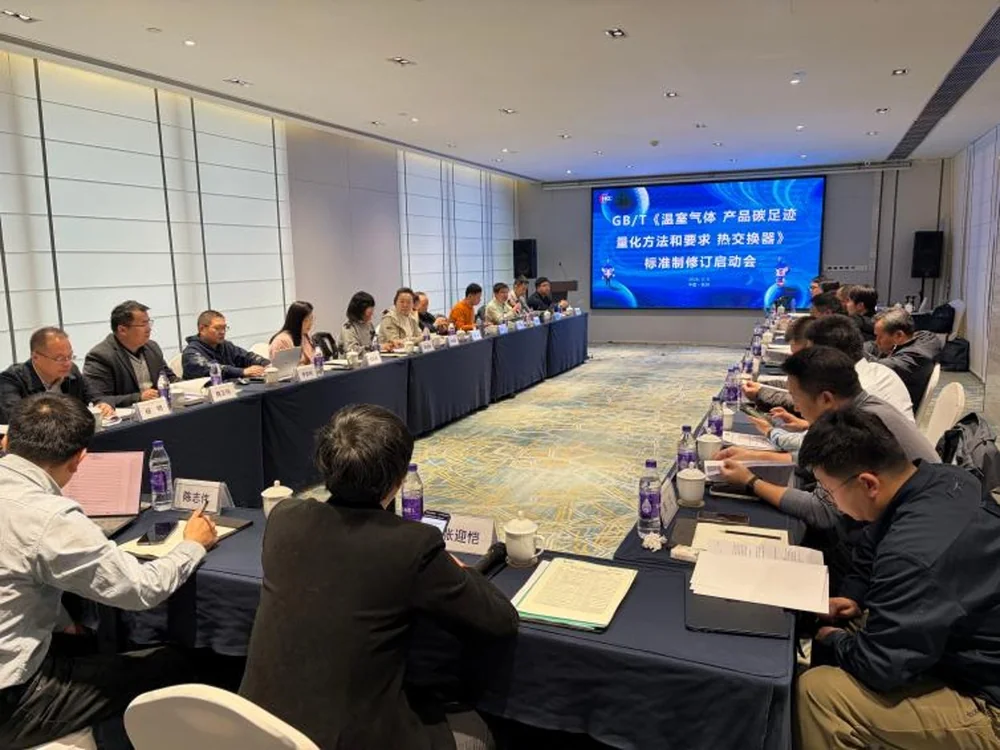
SHPHE's carbon-management work connects manufacturing data with the information customers need for equipment procurement. Following organizational greenhouse-gas verification in 2024 and product carbon-footprint verification in 2025, the company reported an invitation in 2026 to contribute to drafting a heat-exchanger product carbon-footprint standard.
Organizational emissions, a product carbon footprint and participation in standard development describe different activities. Keeping them separate makes the information more useful to an engineering or sustainability team evaluating a supplier.
| Milestone | What it concerns | What a purchaser should request |
|---|---|---|
| 2024 organizational verification | The organization's defined emissions inventory | Reporting period, organizational boundary and verification statement |
| 2025 product verification | The declared exchanger and its assessed product boundary | Product identification, declared unit, boundary and verification report |
| 2026 standard-drafting participation | Contribution to an industry measurement framework | Published project or standard status when relevant |
An invitation to participate in drafting does not mean that a new standard has already been adopted. The 2026 announcement is a record of SHPHE's participation at that point in the standard-development process.
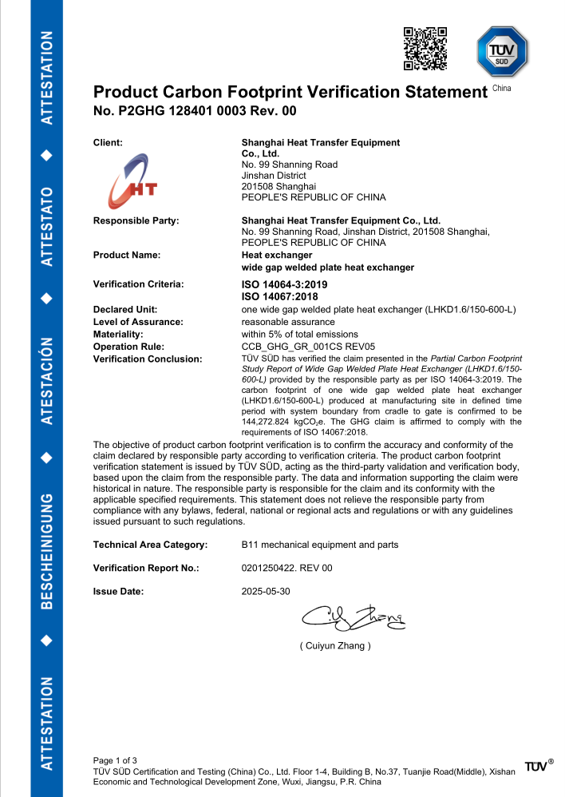
The product statement published with SHPHE's related carbon-footprint announcement identifies a wide-gap welded plate heat exchanger and a cradle-to-gate boundary. That boundary concerns the assessed stages up to the factory gate. It should not be described as verified emissions for every later installation, transport route, operating lifetime and disposal scenario.
The statement identifies ISO 14067:2018 and ISO 14064-3:2019 as verification criteria. Product identification and assessment assumptions are essential when using that document in a supplier evaluation. A different alloy, equipment size or manufacturing route can require a different product calculation.
A wide-gap welded plate heat exchanger can be evaluated for slurry heating, cooling or heat recovery. Its manufacturing footprint and the energy consequences of operating it are related procurement considerations, but they are not the same quantity. Operating energy depends on recovered heat, pumping demand, load profile, fouling and the site's energy supply.
For an equipment comparison, use the same thermal duty and service assumptions. Compare verified manufacturing information on a consistent boundary, then evaluate operating energy over an agreed load profile. This avoids presenting a certificate as proof of a fixed carbon saving at every customer plant.
Trade and disclosure obligations depend on the goods, destination and applicable rules. Product verification is useful evidence, rather than an automatic market-access approval or a promise of reduced border charges. The EU Council's CBAM overview, for example, describes coverage by specified sectors and goods.
When discussing an alumina, sugar, ethanol or wastewater application, identify the proposed exchanger model and material alongside the requested carbon information. SHPHE can then clarify which available documentation relates to that equipment and which project-specific information still needs to be developed.



 English EN