
In a supercritical CO₂ Brayton cycle, a recuperator transfers heat from turbine exhaust to the compressed working fluid before external heating. A PCHE can be attractive because it combines a compact core with a design route for high-pressure service. Its value must be assessed against the complete cycle's heat balance and pressure losses.
The cycle compresses, heats and expands a CO₂ working fluid, recovering part of the remaining heat before cooling the fluid for the next pass. Depending on the cycle arrangement, low- and high-temperature recuperators share the recovery task, while a precooler rejects heat to the available sink.
These components do not have identical operating conditions. A high-temperature recuperator, a lower-temperature recuperator and a precooler require separate thermal profiles, mechanical conditions and materials assessments.
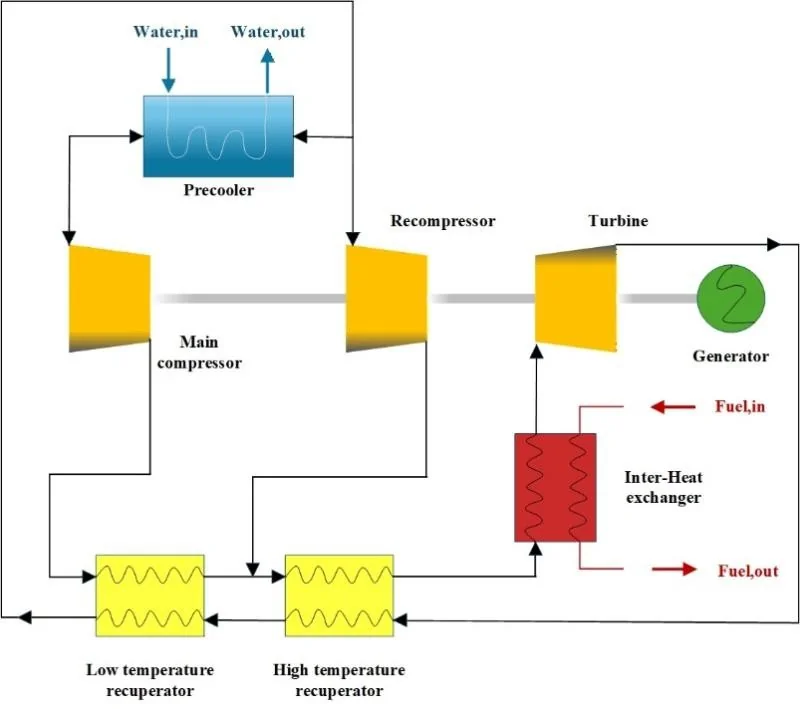
A high recuperator effectiveness can reduce the external heat input needed for the same cycle arrangement. Achieving it may require more surface area or a different channel design. The associated pressure losses can increase compression work or reduce useful expansion.
The target should therefore be net cycle performance, with cost, area and pressure drop included. It is not sufficient to maximize a single exchanger coefficient or to apply a fixed cycle-efficiency improvement to every PCHE installation.
CO₂ properties can vary substantially near the critical region. A single mean specific-heat value may not represent the exchanger accurately. The thermal model should evaluate the relevant pressure, temperature and property variation along the flow path.
For a defined stream, duty can be expressed as Q = mass flow × enthalpy change. As an illustrative calculation only, an assumed 10 kg/s stream with an assumed 100 kJ/kg enthalpy change transfers 1,000 kW. This arithmetic is not a SHPHE test result or a specified cycle operating point.
| Decision | Benefit sought | Trade-off to examine |
|---|---|---|
| Channel geometry | Heat-transfer performance and useful area | Pressure loss, distribution and manufacturability |
| Recuperator duty split | Recover heat across the cycle temperature range | Local approaches and interaction between components |
| Material and core structure | Meet the mechanical and temperature envelope | Thermal stress, cyclic loading and qualification |
| Precooler arrangement | Reach the required compressor-inlet condition | Seasonal heat-sink conditions and auxiliary demand |
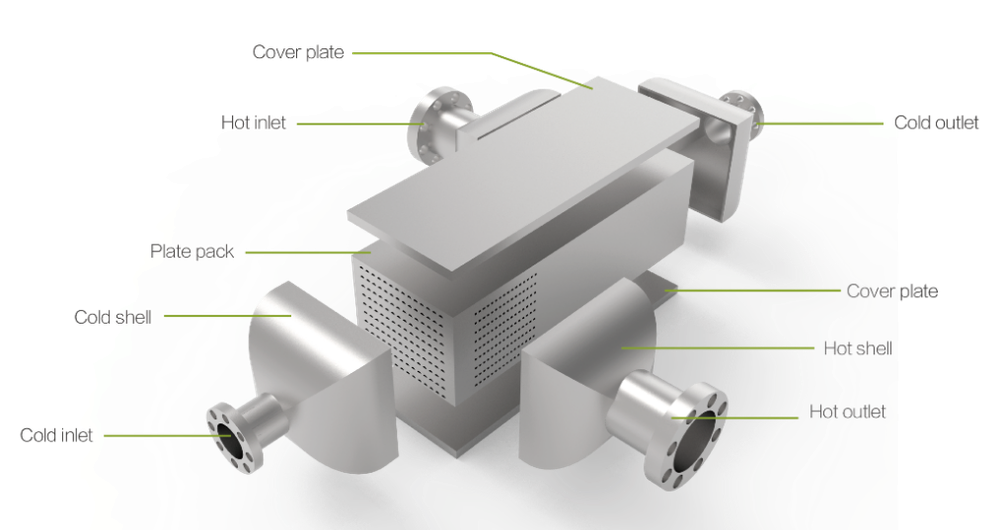
Start-up, shutdown and rapid changes in load can produce temperature gradients and differential pressures unlike the normal steady operating point. The cycle designer should supply the required transients, number of cycles and any ramp constraints for the exchanger assessment.
The printed circuit heat exchanger (PCHE) product family's published upper limits are not evidence that every proposed alloy and geometry can operate at both extremes simultaneously. The supplied equipment requires a defined, qualified pressure-temperature envelope.
Provide the cycle flow scheme, stream compositions, operating-case tables, enthalpy or property basis, pressure-drop limits and target thermal performance. Include transient profiles, design-life requirements and the available space and weight envelope.
SHPHE can use these inputs to assess channel and core options. The resulting exchanger proposal should be evaluated within the cycle model, where its recovered duty and pressure losses can be translated into the project's net output and economics.



 English EN