
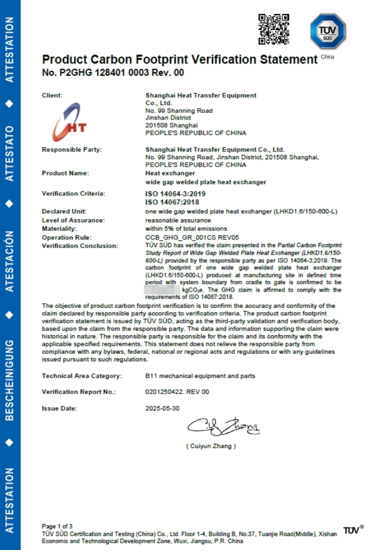
SHPHE's published product carbon-footprint verification statement marks a step toward traceable environmental information for industrial equipment. Issued in May 2025, the statement identifies a wide-gap welded plate heat exchanger and sets out a declared product unit and a cradle-to-gate assessment boundary.
The statement reproduced in the announcement identifies TÜV SÜD as the verifier and lists ISO 14067:2018 and ISO 14064-3:2019 as verification criteria. It concerns the declared product and the boundary stated in the document.
Cradle-to-gate means the assessed product stages extend to the factory gate. That is different from claiming that customer-specific transport, decades of use and final disposal have all been verified for every installed exchanger. The declared unit and full report should remain attached to any use of the reported result.
SHPHE's announcement follows an organizational greenhouse-gas verification statement in 2024. An organizational inventory describes emissions within its reporting boundary. A product assessment allocates the relevant emissions to a defined product and declared unit.
Neither should be substituted for the other in a supplier comparison. A purchasing team should request the statement that matches the information it needs and identify the reporting year, product and boundary.
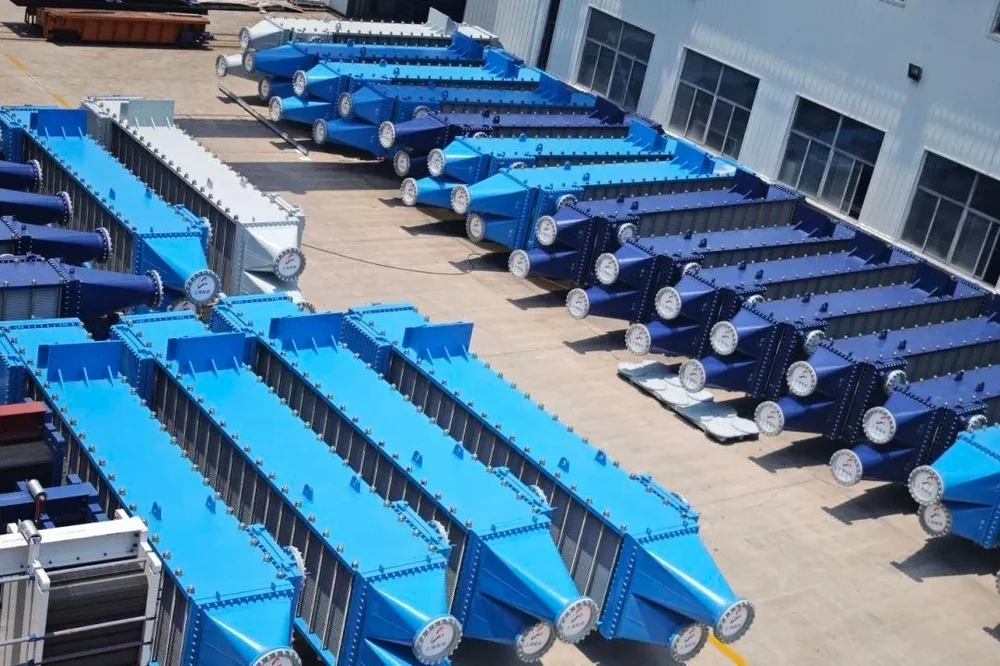
The wide-gap welded plate heat exchanger is evaluated for solids-bearing, fibrous and viscous services, including alumina, sugar, ethanol and selected wastewater applications. Its alloy, dimensions and manufacturing route can change with the duty.
When comparing product carbon information, keep the required heat-transfer service and the product boundary consistent. An exchanger of a different size or material is not automatically represented by the same declared product result.
| Information | Purpose | Required context |
|---|---|---|
| Verified product footprint | Understand assessed product emissions | Declared unit, boundary, method and verification scope |
| Heat recovery or cooling duty | Assess process performance | Same fluid, temperatures and flow cases |
| Pumping demand | Assess operating electricity use | Both-side pressure loss and the relevant operating profile |
| Maintenance and service life | Assess lifecycle scenarios | Explicit assumptions supported by the application |
This separation makes the environmental discussion useful to process engineers as well as sustainability teams. A product statement can support traceable reporting, while the site's energy and carbon consequences still depend on how the equipment is selected and operated.
Identify the exchanger model, material and duty when requesting carbon information. Ask which documentation applies to the proposed supply and whether a project-specific calculation is needed. This provides a sounder basis for procurement than describing a certificate as an automatic “green passport” to every market.
Discuss a wide-gap application and its product documentation →



 English EN